
Barn Owls Go to School: A Story for Preschoolers
📚 Series: All Animals Go to School 📖 Reading time: 3 minutes
Learning to Take the First Step—and Having the Courage to Keep Trying
The first time you write your ABCs, holding a pencil can feel tricky. Your fingers don’t quite cooperate, and your lines, circles, and letters may come out wobbly or uneven. But with every try, your hands grow steadier, and before long, you proudly write a beautiful letter all by yourself.
Numbers are the same way. At first, they may look like mysterious little symbols. Then one day, adding 2 + 2 feels easy.
That’s how learning works. Big achievements don’t happen all at once—they begin with small, brave steps. Every time you keep trying, you’re getting closer to saying, “I did it!”
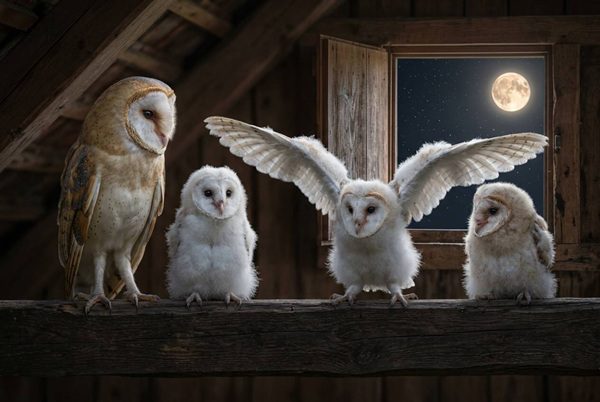
Young barn owls go through the exact same thing. When the owlets grow big enough, their own school days begin.
Only for them, it’s flight school.
As evening settles over the land, the old barn quickly grows dark inside. In the gentle twilight, the owlets’ round, white faces glow like little moons. They wait for their parents, curiously turning their heads from side to side.
These owlets don’t have desks, notebooks, or pencils. Their classroom is made of high wooden beams beneath the roof, dry straw covering the floor, and the quiet stillness of the old barn.
Even after their wings have fully grown, making that very first flight isn’t easy. A young owlet will sit on the edge of a beam for a long time before finding the courage to leap. The world outside seems so big!
Their first lesson is finding the courage to push off.
Out of the evening twilight, the adult barn owls glide in silently. The owlets watch carefully as their parents soar through the air with effortless grace.
At last, one little owlet shuffles to the edge of the beam.
It’s so high!
Finally, the owlet pushes off with its tiny feet. Its wings spread wide, but it just can’t stay in the air yet.
A moment later, the little owl lands in the soft hay below.
That’s okay!
It’s just like making a mistake on your practice paper.
Gripping the wooden post with its tiny claws, the owlet slowly climbs back up and tries again.
Their second lesson is learning to keep their balance.
Now, the young owl needs to spread its wings and stay in the air.
It tries… and flops right back into the straw.
But it doesn’t give up. It tries again. And then, again.
Day after day, the young owls practice in their barn.
As time passes, their wings grow stronger and stronger. The clumsy little owlet from yesterday now flies confidently from one beam to another. It lands softly, folds its wings, and grips the wooden beam tightly with its tiny feet.
It did it!
That evening, the tired little owlet returns to its cozy nest. It snuggles beneath its mother’s wing and falls fast asleep.
One day, you’ll come home from school, give your mom a big hug, and tell her how neatly you wrote your letters today.
You see, my friend, both children and young barn owls begin with small first attempts before they master big things. At first, you can do only a little… just a tiny bit… And then, one day, you suddenly realize you can do something that seemed impossible only yesterday.
An that’s when we learn to fly.
Read the other free stories from the “All Animals Go to School” series

✨ Did you know?
- Barn owls fly almost silently. The soft edges of their feathers help them glide so quietly that their prey often never hears them coming.
- A barn owl’s face is shaped like a heart. Its white, heart-shaped face makes it easy to recognize among other owls.
- Barn owls have incredible hearing. They can hear a mouse even in tall grass or beneath a thin layer of snow.
- Barn owls rest during the day and wake up in the evening. They are nocturnal birds, and most of their flying and hunting happens after sunset.
- Young barn owls take a long time to learn to fly. At first they hop, flap their wings, and make short flights. Their parents continue feeding them until they become confident fliers.
- Barn owls like to nest in old barns, sheds, and church bell towers. These places provide a safe home for raising chicks and easy access for hunting.
- A barn owl can turn its head almost 270 degrees, helping it notice everything happening around it.
- Barn owls’ eyes face forward, allowing them to judge distances to their prey with great accuracy.
- Parents care for their young for quite some time. Even after the first flight, adult barn owls continue bringing food until the young birds become independent.
- Barn owls have very long wings. They allow them to fly slowly, smoothly, and almost silently.
- Barn owls are helpful to people. They catch large numbers of mice and voles that can damage crops.
📖 Vocabulary Building
- Barn — a large wooden building on a farm where hay, grain, or sometimes animals are kept.
- Beam — a thick wooden support beneath the roof that birds can perch or walk on.
- Barn owl — a nocturnal owl with a white, heart-shaped face. It flies almost silently.
- Loose hay — soft, dry grass gathered into a large pile.
- Balance — the ability to keep your body steady without falling.
📚 Questions About the Story
- Why couldn’t the little owl fly on its first attempt?
- What helped the young barn owls learn to fly?
- Why didn’t the little owl give up after its first unsuccessful try?
- What were the two most important lessons in flight school?
- How is the barn owls’ school similar to a children’s school?
- What new fact did you learn today about barn owls?
- What are you learning right now, just as the little owl was learning to fly?
🌱 Questions to Think About
Why do you think great skills don’t appear all at once?
What would you say to the little owl after its first unsuccessful attempt?
Can you remember something that seemed difficult at first but became easier with practice?
🪶 Group Game: “Barn Owl”
For preschool, school, or a large group.
How to play:
- Choose one player to be the barn owl. During the day, the barn owl “sleeps” with its eyes closed in its “nest.”
- While the barn owl is sleeping, the other children—the other birds—can move around the room, hop, spread their “wings,” and practise flying.
- When the leader calls out, “Night falls!”, the barn owl “wakes up” and begins flying around the “sleeping” birds (flapping its “wings” while slowly walking around the room). All the other birds must freeze and stay completely still.
- Anyone who moves becomes the barn owl’s prey, and the owl “carries” them back to its nest.
- The leader then announces, “Daytime!” The barn owl “flies back to its nest,” and the other birds are free to move and play again.
- The winner is the bird who manages to avoid being caught for the longest time.
🪶 Family Game: “Day and Night”
For home and any number of players.
How to play:
- All players become little owls.
- The leader says, “Daytime!” The little owls fall fast asleep wherever the night found them. They close their eyes and stay perfectly still.
- The leader calls, “Nighttime!” The little owls wake up, spread their “wings” wide, and begin flying around the room.
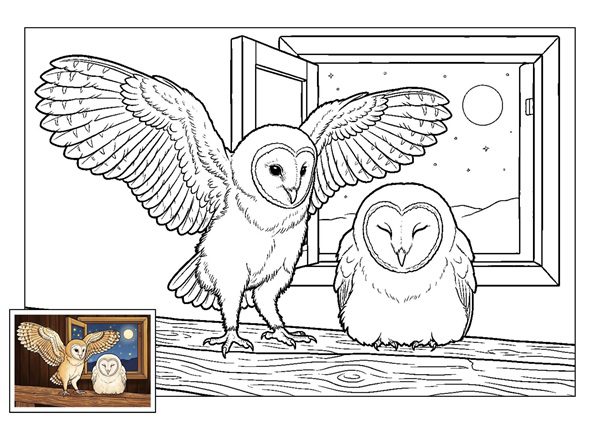
🎁 Barn owl coloring page — free gift
📚 This story is part of the book “All Little Animals Go to School”
“Barn Owls Go to School” is one of 7 therapeutic stories for children aged 4–7 that will appear in the first book of the “All Little Animals Go to School” series.
Each story introduces children to the fascinating world of animals, helps them prepare for school with confidence, and turns reading into an enjoyable activity for the whole family.
Inside the book you’ll find:
- 📖 7 therapeutic stories about European animals
- 🌿 Fascinating facts about nature
- 💬 Discussion questions and language development activities
- 📚 Vocabulary exercises
- 🎲 Games for families and group learning
- 🎨 Original colouring pages for every story
Age: 4–7 years
📄 Format: PDF eBook for reading and printing.
✨ The book is currently being prepared for release.
You have already read one story completely free of charge.
Very soon, you’ll be able to enjoy 6 more new stories, together with games, colouring pages, and educational activities that make getting ready for school fun, calm, and enjoyable.
📩 Would you like to be among the first to hear when the book is released?
Email me at crasnoum@gmail.com, and I’ll be happy to let you know as soon as the book is available to download.