
Turn reading into a joyful holiday adventure where your little one is the star of the show! These short Easter stories are designed so that your child doesn’t just listen—they hop, clap, and “bake” Easter treats right along with the characters. These original Easter tales for toddlers up to 2–3 years old are the perfect tool for a gentle introduction to speech through play and sound imitation.
The heart of these stories is interactivity and personalization. Use your child’s name (or Mom’s, Dad’s), a pet’s name, or a favorite toy instead of the emojis in the text: for example, “Boy 👦” becomes “Dany.” That way, every story feels one-of-a-kind and truly personal!
Why are these stories for the very youngest so special?
Children under 2 experience the world through sounds and movement. At this age, they don’t need complex plots, so these Easter stories are built on the “active listening” method:
- A gentle start to speech through rhythm—the repeating “tap-tap” and “hop-hop” invite your child to echo the sounds.
- Simple Easter tales as a ready-made activity—each story includes playful actions (petting, clapping) that double as a fun motor-skills lesson.
A sense of celebration, right here and now—short texts keep them engaged without overloading their attention, bringing joy in the moment.
The Tale of the Hen 🐔 and the Chick 🐥
(Speech Development)
Make it your own: swap emojis for names to bring the story to life!
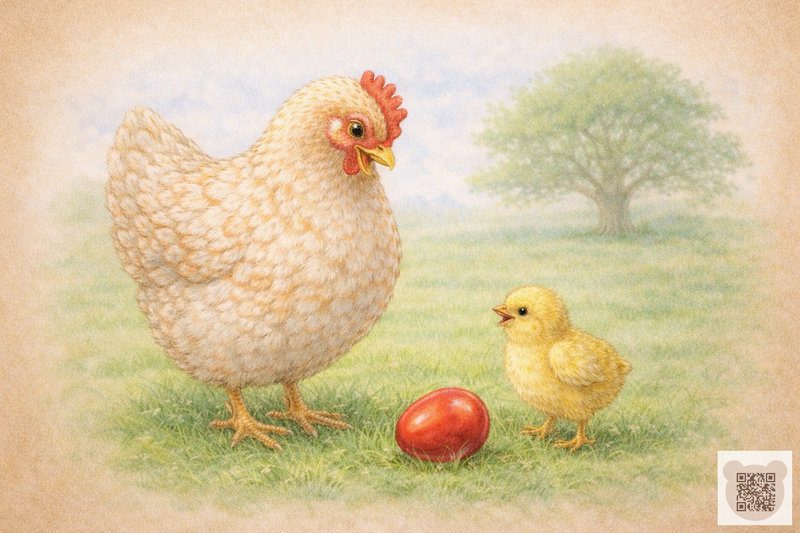
Once upon a time, there lived a Mama Hen 🐔 (Lena).
She was big and beautifully speckled.
And she had a little daughter—a tiny chick 🐥 (Anya).
The daughter 🐥 was yellow as sunshine and downy-soft.
(Gently stroke your child’s tummy or hands)
Mama 🐔 calls: “Cluck-cluck-cluck! Come here, my little chick!”
Daughter 🐥 runs: “Peep-peep-peep! I’m coming!”
(Walk your fingers over the child’s body—make them “run” to your little one)
Mama Hen 🐔 flaps her wings—clap-clap-clap.
(Clap your hands together like wings)
Daughter 🐥 flaps her wings—flap-flap-flap.
(Gently wave your child’s hands)
They look—and there is an egg lying in the grass.
Not just an ordinary egg, but a bright Easter egg!
Red, shiny, and beautiful.
(Press your palms together and roll them like an “egg”)
Mama 🐔 taps with her beak: “Tap-tap-tap” on the egg.
Daughter 🐥 taps with her beak: “Tippity-tap.”
(Gently tap your finger on the child’s palm)
What a sturdy little egg—it won’t crack!
Mama 🐔 and daughter 🐥 danced for joy.
(Spin around or dance together while sitting)
“Easter is here!” sings Mama 🐔.
“Peep-peep-peep!” cheers the daughter 🐥.
Mama 🐔 hugged her daughter 🐥 with her warm wing,
(Give your little one a big, gentle hug)
and the whole yard was filled with light and happiness!
(Laugh and cheer together)
A tale of the bunny 🐰 and his papa 🐰
(playing hop-skip)
Make it your own: swap emojis for names to bring the story to life!
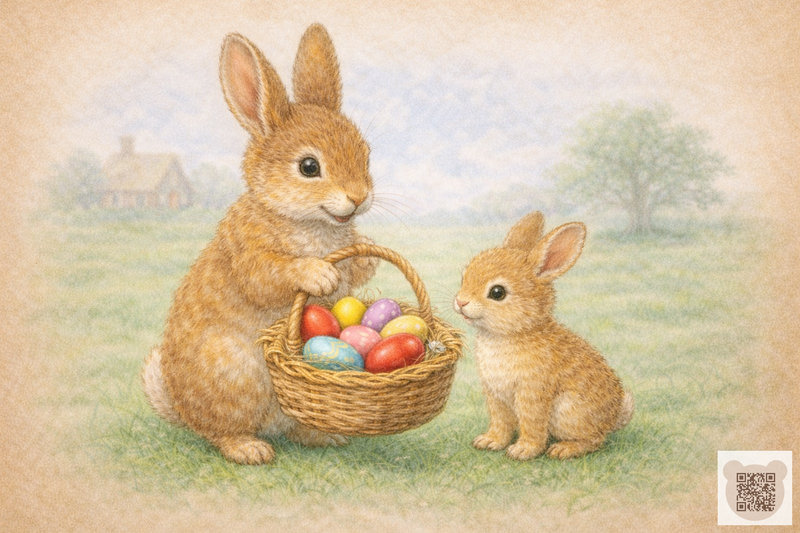
Once upon a time, there lived a big Papa Rabbit 🐰 (Dima).
And he had a little son, a tiny bunny 🐰 (Sasha).
Rabbits have long ears and strong little paws.
(Make “ears” with your hands, then flex your arms—show those “strong muscles”)
Papa 🐰 says: “Hop, my son!”
Son 🐰 hops: “Hop-hop, hop-hop!”
(Hop your fingers over the child’s knees—first heavy and slow like “Papa,” then quick and light like “Son”)
Papa Rabbit 🐰 brought out a big basket.
Inside were colorful Easter eggs.
Son 🐰 peeked into the basket: “Oh! So pretty!”
(Open your eyes wide and round your mouth together with your little one)
Papa 🐰 and Son 🐰 went along the path.
Trot-trot-trot—they go along merrily!
They came to a little house, bringing Easter bread and eggs.
Papa 🐰 knocks on the door with his paw: “Knock-knock-knock!”
(Knock with your fist on the sofa or floor)
Son 🐰 wiggles his tail: “Wiggle-wiggle-wiggle!”
(Tickle the child, pretending to be the tail)
Everyone came out to greet the rabbits, cheering: “Easter is here!”
Papa 🐰 lifted his son 🐰 up high, high!
(Lift your child up in your arms)
Son 🐰 laughs: “Ha-ha-ha!”
Papa 🐰 is merry, and Son 🐰 is glad.
The sun is shining, the eggs are gleaming,
and the whole forest is filled with light and happiness!
(Laugh and rejoice together)
A tale of the Easter bread, Grandma 👵, and the boy 👦
(Everyday Play)
Make it your own: swap emojis for names to bring the story to life!
The boy 👦 went to see Grandma 👵.
Grandma 👵 is kneading the dough.
Press-press, squeeze-squeeze.
(Gently massage your child’s palms or back)
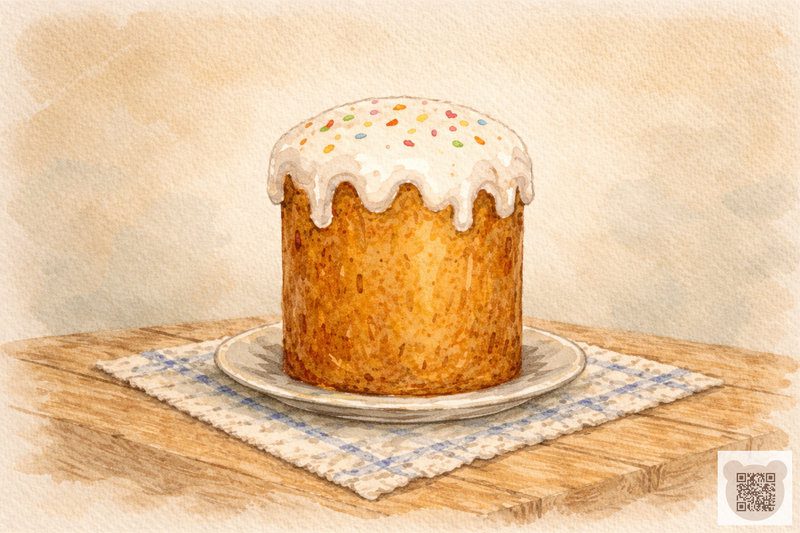
Out came a little loaf of Easter bread.
The dough is white and ever so soft.
(Gently stroke your child’s hands)
Grandma 👵 put the bread into the oven.
Inside the oven, it’s warm-warm-warm.
(Give your child a warm hug)
The boy 👦 sat down on his little chair.
He waits and waits and waits.
Where is the Easter bread?
(Spread your arms out in surprise)
And the bread in the oven goes: “Puff-puff-puff!”
It grows and grows and grows.
(Slowly lift your child’s hands upward)
The bread grew big and golden brown!
Grandma 👵 took it out of the oven.
The boy 👦 goes: “Sniff-sniff-sniff.”
(Sniff the air together)
It smells so yummy-yummy!
Grandma 👵 decorated the bread with white “snow” icing.
Swish-swish-swish goes the brush.
Tap-tap-tap—the sprinkles come tumbling down.
(Lightly tap your fingers on your child’s head or shoulders)
The boy 👦 hops for joy—hop-hop-hop!
Grandma 👵 smiled, and the boy 👦 smiled too.
(Smile at each other)
The Easter bread sits proudly on the table,
and the whole house is filled with light and happiness!
(Laugh happily and twirl together)
A tale of the little egg, Grandpa 👴, and the girl 👧
(active play)
Make it your own: swap emojis for names to bring the story to life!
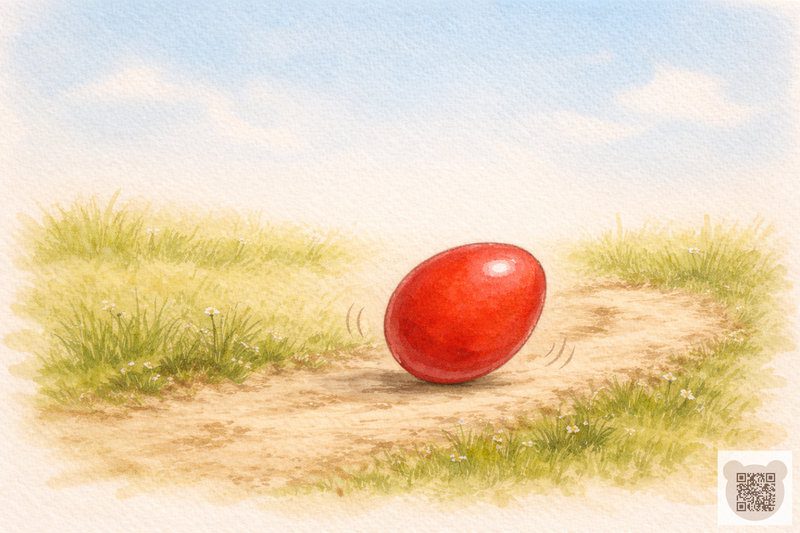
Once upon a time, there lived Grandpa 👴 and a little girl 👧.
The girl 👧 was tiny, and Grandpa 👴 was very kind.
On the table sat a bright red egg.
The egg was round-round-round.
(Trace a circle on your child’s palm with your finger)
The girl 👧 gave it a tiny tap with her finger—boop!
(Gently touch your child’s palm)
And the egg—off it rolled!
Roll-roll-roll, roll-roll-roll.
(Quickly “run” your fingers along your child’s arm from shoulder to hand)
Oh no! The egg escaped out the door!
(Press your palms to your cheeks and shake your head)
Grandpa 👴 chases after it: “THUMP-THUMP-THUMP!”
The girl 👧 chases after it: “Patter-patter-patter!”
(Stomp your feet together—heavy for Grandpa, light for the girl)
The egg rolled and rolled,
and right into the girl’s basket 👧—plop!
(Hide your child’s little fist inside your palms)
Grandpa 👴 says: “Oh!”
The girl 👧 says: “Ah!”
Look, the basket is full of eggs!
(Spread your arms wide)
Red, yellow, and blue.
So pretty, pretty, pretty!
(Gently stroke your child’s head)
Grandpa 👴 smiled.
The girl 👧 laughed: “Ha-ha-ha!”
(Clap your hands joyfully)
Easter is here, bringing so much joy!
The egg sits snugly in the basket,
and the whole house is filled with light and happiness!
(Laugh merrily and twirl together)
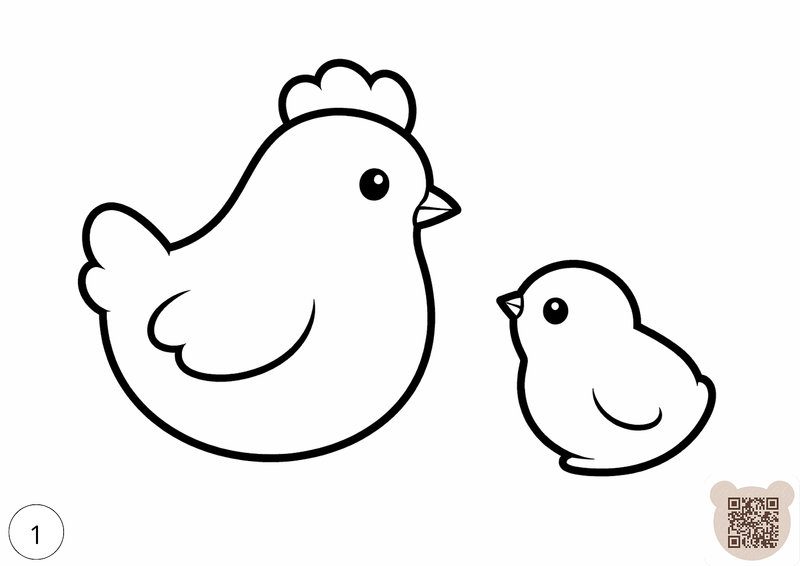
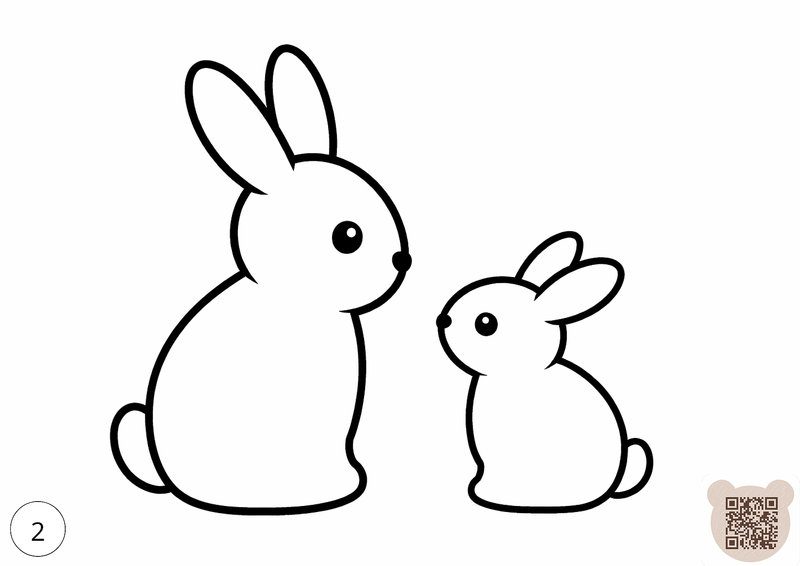
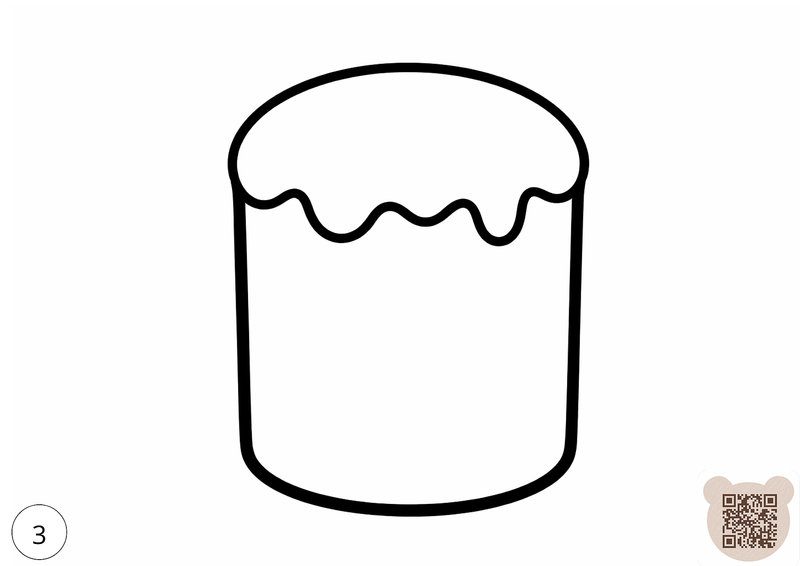
Unique Easter coloring pages inspired by the mini-tales for children under 2
How to use the coloring pages: read these 3 tips that are total “game-changers.” To turn ordinary coloring into a developmental show for your little one, try these techniques:
- “A Living Story” (finger-puppet play): don’t just color—bring the characters to life! While the child swipes a finger over the bunny’s outline, give it a voice: “Hop-hop! Bunny is hungry!” When the picture “talks” to a child, engagement grows fivefold.
- A sensory burst (3D coloring): instead of markers, use a glue stick and textured materials. Smear glue on the rabbit’s “tummy” or the Easter bread’s “icing,” and let your little one sprinkle cornmeal or oats. It’s not only coloring—it’s a powerful fine-motor workout with a wonderfully tactile result.
- The magic of “the big reveal”: beforehand, draw patterns (dots, stripes) on the white parts of the page with a white wax crayon. When the child paints the egg or bread with watercolors, the patterns will “magically” appear on the sheet. To a one-year-old, it looks like a true miracle!
Support the creation of new fairy tales for children! ❤️


How to make reading an Easter story interactive and joyful
To help these short Easter tales bring the most benefit and delight, turn reading into a game:
- Personalize the story. Use your child’s name or a favorite toy instead of the emoji: “Boy 👦” → “Dany,” “Chick 🐥” → “Lena.” This makes these Easter stories feel deeply personal and captivating.
- Act it out. Don’t just read—show it! Hop like the bunny, “bake” the Easter bread with your palms, and mimic the sounds: “cluck-cluck-cluck,” “peep-peep-peep,” and “pat-pat-pat.”
- Use props. Read next to a real Easter basket, or let your little one hold an egg. A visual cue helps children connect with these simple Easter tales much better.
- Echo the characters. Encourage your child to repeat simple gestures and syllables. This builds motor skills and lays a strong foundation for speech.
An example of an interactive technique
- Call your child by name: “Little Sasha rolls the egg.”
- Read a line with a rhythmic beat: “The egg goes roll-roll-roll!”
- Invite them to copy you: roll your palm along your child’s arm or mimic the motion together.
- Point to the picture or object: “Look—what a bright red egg!”
Who are these stories for?
- For babies under 1: The most important elements are very short stories where your voice, sound imitation (“peep-peep,” “yum-yum”), and gentle touch take center stage.
- For toddlers aged 1.5–2: They are ready for plots with simple actions (“went,” “found,” “hugged”) that a child can recognize and imitate.
- For speech development: These stories for the very youngest are inspired by traditional nursery rhymes. Rhythmic phrases and familiar scenes are the perfect way to read Easter tales to toddlers in a way that is clear, cheerful, and never dull.
Add your little one’s name, a pinch of play, and a sincere smile—and the Easter holiday will come alive right in your hands!
Frequently asked questions about simple Easter tales
- At what age can you start reading these simple Easter tales?
The texts are perfectly adapted for toddlers from 1 year to 2.5 years old. They keep descriptions to a minimum while providing plenty of easy, familiar sound imitations.
- How do you use the interactive name inserts?
Instead of the emoji 👦 or 👧, simply insert your child’s name. It turns reading into a personal story where your little one becomes the main character.
- How do these short stories help with speech development?
They provide a gentle “kickstart” for speech through repetition, help build attention spans, and use play to introduce your little one to holiday traditions.
- Can you use these stories as a game script?
Absolutely! Each story is a ready-to-go 5-minute activity plan: complete with movements, sounds, and a simple task at the end.
- Where can I find a printable version?
Click the “Download PDF” button (at the top of the page or under the story) to get all the stories, illustrations, and coloring pages in one file.