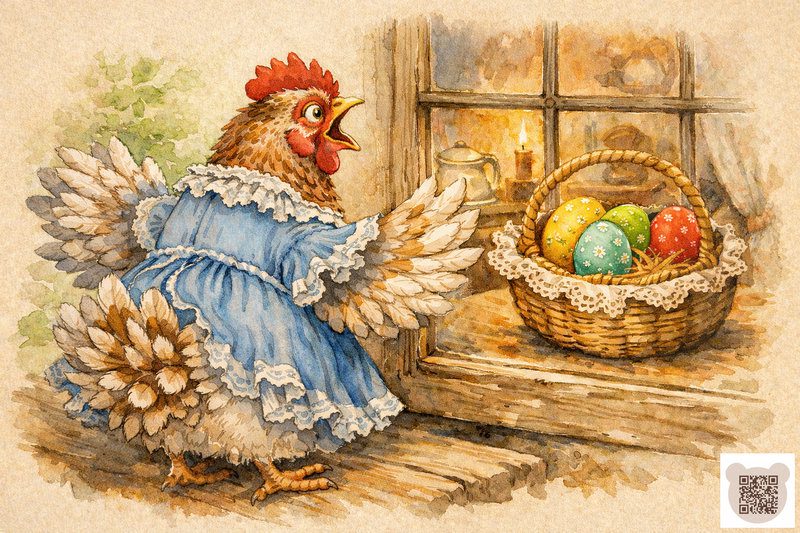
This new Christmas tale for 2025/2026 is based on true events and reaches back into the winter of nineteenth-century London. It is the story of a little thief named Finn and Arthur, the son of a seamstress, whose fates crossed on Christmas Eve. Together they will share with readers the quiet magic of forgiveness and prove that even in the darkest slums one may still find a path toward the light. How will this story end, a story that began in such sorrow? Read it on our website!
A Copper Compass for a Little Thief

Dear Parents!
What you hold before you is not merely a story, but a Christmas fairy tale, written in the finest traditions of the Yuletide genre. It is perfectly suited for reading aloud together. This story will help you speak with your children about compassion, mutual aid, and true values. In the final pages, you will find a historical note and discussion questions that will turn reading into a thoughtful and warmly shared family lesson.
The characters of the tale are inspired by real events:
-
Finn (7 years old) — a scrawny little jumper (a thief who slips through windows). He knows nothing of morals; only cold and hunger are familiar to him.
-
Silas (14 years old) — his elder brother, once a master thief, now too broad-shouldered for narrow frames. Slowly fading from a relentless cough.
-
Father (Bill) — a hard man who drinks away the spoils, seeing his sons as nothing more than tools.
-
Mrs. Eloise — a seamstress whose world has shrunk to the tip of her needle.
-
Arthur — her son, dreaming of a life beyond the slums.
Part 1: The Copper Needle
Fog crept down the filthy brick walls of London, clinging to sagging rooftops and seeping into every crack. It was December of 1850. Less than a fortnight remained until Christmas, yet for seven-year-old Finn it was simply the coldest stretch of the year.
“Hurry, Finn. The constable will circle the block in five minutes,” Silas hissed from the alley’s darkness. His fourteen-year-old frame could no longer squeeze through a fanlight, but he was still the eyes and ears of his younger brother.
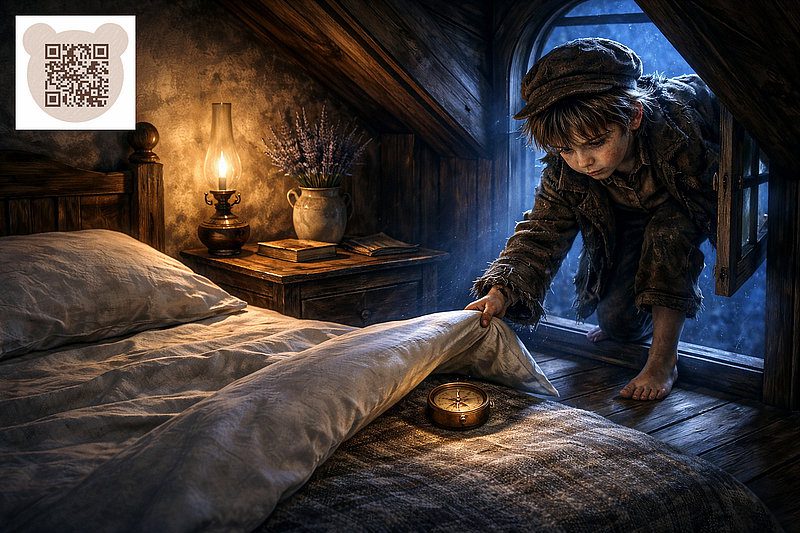
Finn nodded. He was thin and nimble, as though born to slide through gaps too small even for a rat. Hooking himself deftly onto a drainpipe, he kicked off his boots so they would not slip on the ice, hauled himself upward, and vanished through a tiny attic window.
Inside, the air smelled strange to him—not of sour ale and cellar mould, but of lavender and soap. The pale walls seemed painfully bright even in the gloom. Finn felt his way forward. Silas stood watch outside, listening for footsteps, while Finn set to work—searching for anything of value.
He rifled through an old chest of drawers. There was little inside: worn clothing, neatly folded. Poor folk, Finn thought. In the corner, beneath a thin pillow, his fingers found something solid wrapped in rough leather. He drew it out. Inside, housed in a scratched copper case, lay a simple compass.
For Mrs. Eloise the seamstress, it had been a great extravagance. She had saved a penny at a time for half a year, denying herself even tea, to buy this second-hand item from a rag-and-bone shop. She wanted her son Arthur—who dreamed of becoming a sailor and seeing the wide world—to believe that even from London’s dead-end slums one could still find a way forward.
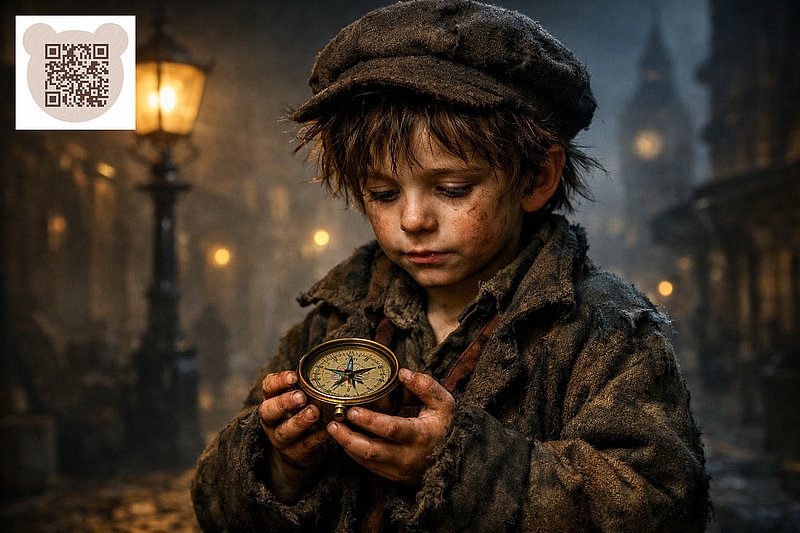
Finn did not understand what the object was for. He knew only that a pretty thing could be sold. Yet the tiny needle, trembling in the moon’s dull glow, bewitched him. It seemed alive, pointing toward some secret known only to itself. The boy slipped the compass deep into a tear in the lining of his trousers.
“All done,” he whispered, dropping back into his brother’s arms.
Part 2: A London Cellar
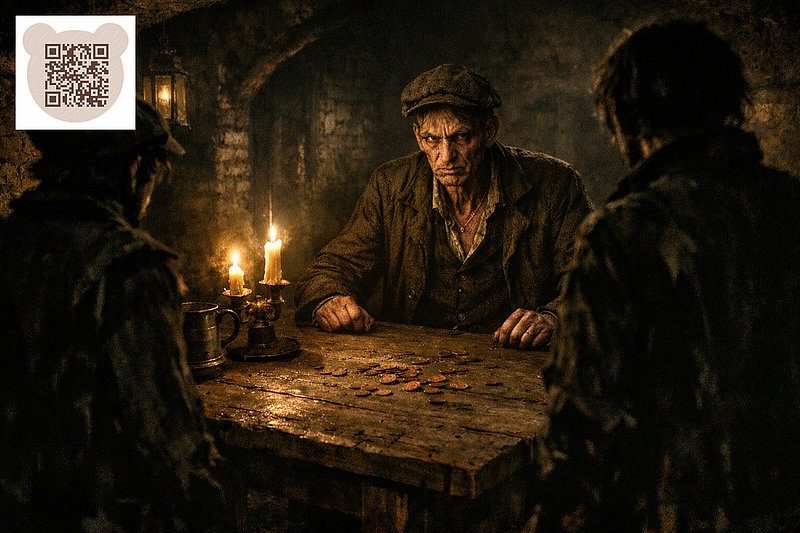
At home, in their damp cellar, their father was waiting. Bill had already taken comfort from a bottle of cheap gin. He was a harsh man who saw his sons as nothing but means to earn coin.
Finn laid their meagre haul on the table: a silver thimble and a couple of copper coins. Their father spat in disgust.
“That’s it? You useless brats!”
He did not notice how Finn instinctively pressed a hand to his thigh. The compass had slipped deep into the trouser lining, snagged on a coarse seam. For a moment, Finn himself forgot about it, stunned by his father’s shouting. Bill scooped up the coins and staggered toward the door.
“I’m off to the Lame Goose. Don’t you dare light the candle stub while I’m gone!”
That night, Finn lay on a prickly straw mattress. When the noise had died away, he felt something hard pressing against his leg. He drew out the compass. In the cellar’s half-light, the needle continued its mysterious dance. Finn did not know where it led, but for the first time in his life he dared not hand over his find to his father. He decided to keep it—at least until morning.
Part 3: Beneath Waterloo Bridge
The very next day, the boys’ lives were overturned. Bill, as usual, picked a fight in a public house. This time luck deserted him: he split the head of a respectable shopkeeper and was seized by the arriving police. For violent conduct and old offences, he was swiftly clapped in irons.
The brothers were left alone. Without their father’s feared name, they were quickly thrown out of the cellar for unpaid debts. Bigger, crueller thieves drove them from their familiar streets. Finn and Silas became shadows drifting through a festive city where shop windows glowed with light. Their pockets were utterly empty. Finn’s only treasure was the copper compass, which he now never let out of his grasp, hiding it deep within his ragged trousers.
That winter was merciless. An icy wind off the Thames pierced the city, while thick yellow fog turned the streets into a maze of phantoms. After their father’s arrest, Finn and Silas learned that London was like a vast, greedy beast that spared the weak no pity.
They tried to join a gang at the flower market, but the local leader—a one-eyed lad of about sixteen—only laughed at them.
“Clear off, little jumpers,” he spat. “Every inch here’s paid for. Be gone before I hand you to the constable for sport.”
The brothers moved on. They wandered the streets, hoping to snatch something—anything—to eat, but holiday London was watchful: shopkeepers gripped their cudgels, and police patrols were doubled. Silas, always Finn’s protector, began to fail. His cough grew heavy and wet, and his face took on an ashen hue.
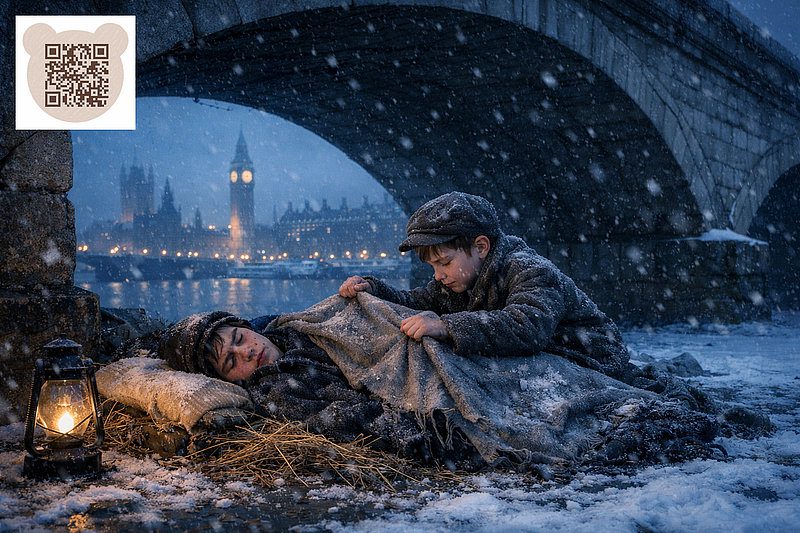
At last they settled beneath the span of Waterloo Bridge. There, among discarded rubbish and damp stone, was the only place no one chased them away.
“Finn…” Silas whispered one evening, as the city sank into the twilight of Christmas Eve. “I… I can’t get up.”
He lay on a heap of filthy straw, his brow burning hot. That night they could not even find potato peelings. Finn stared at his brother in terror. He thrust a hand into his pocket and felt the copper body of the compass. All those weeks he had taken it out again and again, gazing at the scratched glass, watching the needle point faithfully in one direction. He could not read, but the letters on the dial—N, S, E, W—seemed to him like magic spells.
The compass was his secret strength, his only tether to a world where hope still lived.
Part 4: Christmas Eve for the Homeless
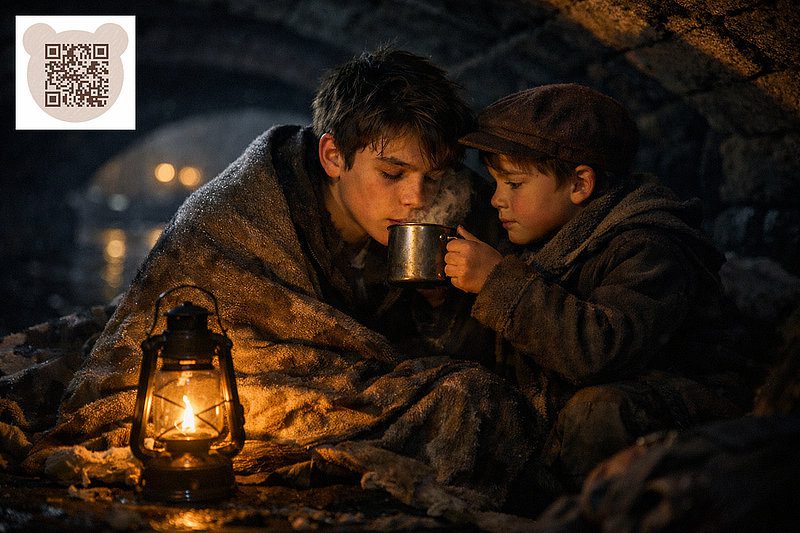
Silas’s breathing grew harsher by the hour, a wet rasp tearing at his chest, and his lips turned blue with cold. Finn understood with dreadful clarity: if he did not find food and something warm to drink, this Christmas would be his brother’s last.
The boy scrambled to his feet and, stumbling through the fog, ran toward a rag-and-bone shop at the edge of the district. The shopkeeper was already preparing to shutter his door.
“What’ve you dragged in, little rat?” the old man grunted.
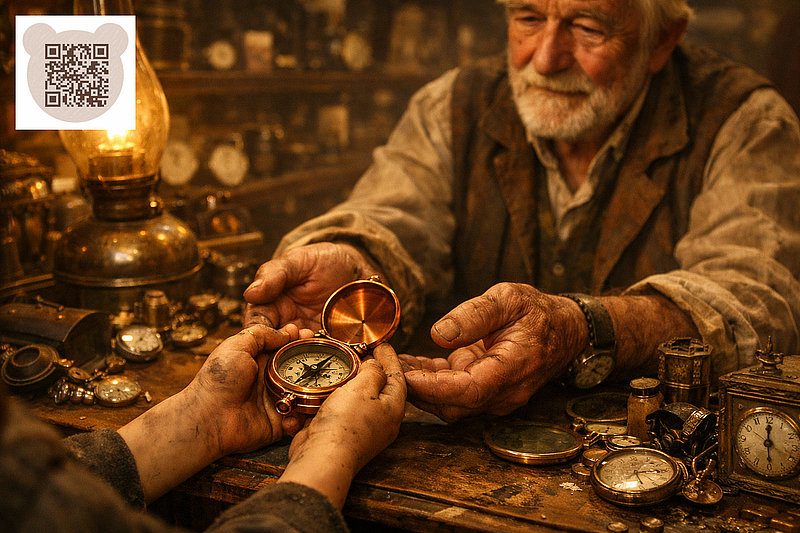
With shaking fingers, Finn placed the compass on the counter. The copper gave a dull glimmer in the light of a kerosene lamp. The shopkeeper squinted, flipped the lid, and sniffed.
“Worn thin. Glass all cloudy. I’ll give you four pence—and not a farthing more.”
The words struck Finn like a blow to the chest. His treasure, his living needle, worth only four copper coins? But behind the shopkeeper, on a shelf, stood a tin kettle sending up curls of steam.
“Sbiten!” Finn croaked. “Please, sir—sbiten. And bread.”
Ten minutes later Finn was running back beneath the bridge. In one hand he clutched a flask of hot, spiced honey drink; in the other, two fresh, soft rolls. The compass was gone. In its place yawned an emptiness that made his heart ache. Yet when he poured the first mouthful of steaming sbiten between Silas’s lips, and the shivering eased, Finn knew he had done the right thing.
They ate the bread in complete darkness, listening to carriages thunder across the bridge overhead. Silas fell asleep, his breathing steadier now. Finn pressed close, trying to warm his brother with his own small body. That night, beneath the icy bridge, Christmas came quietly—and bitterly.
Part 5: Christmas in the City
Christmas morning, the twenty-fifth of December (how swiftly time flies!), dawned blindingly white. Snow covered London’s filth like a clean sheet. Above the boys’ heads, well-dressed folk streamed across the bridge.
Among them was Mrs. Eloise. She held Arthur by the hand as they walked toward a charitable dinner at the parish church. Arthur looked downcast. He knew his mother had spent everything to buy his gift, and now they had neither the compass nor money for another.
By chance, Arthur glanced over the parapet. Below, on the steps leading down to the water, sat two figures. The smaller one was sadly holding an empty leather case, sewn by Eloise herself from an old glove—Finn had not been able to part with it; the shopkeeper had no use for such a thing.
Mrs. Eloise looked down as well and recognized her stitching at once. She stopped short, pressing a hand to her heart in astonishment.
Finn understood instantly—such was the sharp instinct of a London street child—and froze, waiting for the cry of “Thief!” or the whistle of a constable. He shielded Silas, weak with exhaustion. But Arthur noticed the empty flask, the crumbs of bread, and the elder brother’s pale, ravaged face. He understood everything. He understood that his lost compass had become a draught of life for this suffering child.
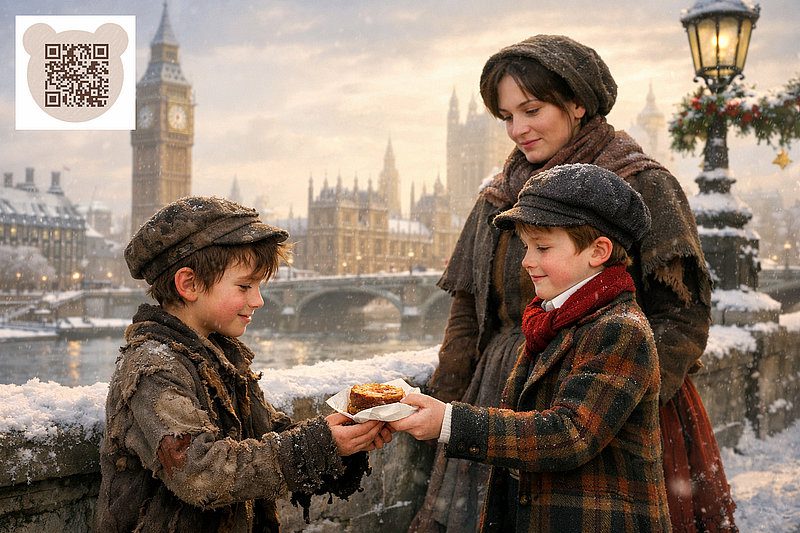
Arthur untied the bundle holding a warm Christmas pie—baked by his mother for the church meal from their last flour and treacle. He stepped down a couple of stairs and held the pie out to Finn.
“My compass showed me the way to you,” he whispered, meeting the little thief’s eyes. “Eat. It’s Christmas.”
Finn was struck dumb. He took the pie, feeling its warmth through the paper. Mrs. Eloise spoke no word of reproach. She merely adjusted her shawl and nodded to Finn. Her eyes were very sad.
Part 6: The Story’s End
Time passed. The seamstress did not turn the boys over to the police. Instead, she spoke of them to an acquaintance—a master boilermaker. Silas was taken on as a helper, hauling coal and cleaning furnaces. The brothers now lived in the workshop. They slept in a corner atop a great heap of black coal. To some it was filth; to them it was the warmest, safest place in the world. Each morning the master handed them a large bowl of thick oatmeal with dripping.
Finn no longer stole. His clever fingers learned to handle tools instead of rifling through other people’s pockets.

Epilogue: Rust and Steel
Twenty years went by. London of the 1870s bristled with factory chimneys, and the sky above the Thames had darkened forever with soot.
Silas never became a rich man, but he ceased to be a shadow. Years by the furnace turned him into a sinewy coalman, scorched by heat. Coal dust worked so deeply into his face and hands that no soap could ever scour it out. He became a senior stoker at a manufactory—heavy, filthy labour that made his back ache, yet gave him what his father never had: certainty of tomorrow and a pair of sturdy boots. He no longer coughed blood, though his voice grew rough, like a shovel scraping anthracite.

Finn found honest use for the fingers that once slipped latches. He did not become a gentleman, but he became a blue-collar man—a skilled mechanic in a clockmaker’s shop in the City. His bench was strewn with gears and springs. The fine work paid enough for a rented room with a window he did not have to climb through in secret. Oil always blackened his nails, and in a small box on his table lay that same leather compass case. Finn never threw it away—it was the only trophy from his former life worth keeping.

Arthur did not become what he had dreamed of—a sailor. Instead, he worked as a cartographer at the Admiralty. It was clean and respected work, yet he remained a laborer at heart. He spent his days bent over maps, drawing coastlines he would never see with his own eyes. His world was still measured by precision and direction.

They never met again. Life in London rarely brings together people of different classes twice.
One day, Arthur happened upon his old copper compass in a rag-and-bone shop and bought it back. The glass was clouded, the case scored with deep scratches. Who knows, dear readers, whether it was the very compass that had bound their lives together that Christmas midnight—or another like it? Yet its needle still trembled stubbornly, pointing north.
And Finn and Silas, every Christmas Eve without fail, ordered a hot meat pie from a street hawker. It was sent to that same attic room where Mrs. Eloise still bent over her sewing. Only now her needle no longer worked for fine ladies—it stitched tiny shirts for one splendid little child, her grandson.
As she cut the pie and breathed in its rich aroma, she thought how that long-ago night had not been magic or enchantment at all. It was simply London—where three people once found their true direction. And it did not matter that only one of them held a compass that night.
Support the creation of new fairy tales for children! ❤️