What would happen if, on the most magical night of the year, the moon were to vanish, the Devil took to mischief, and a simple-hearted blacksmith dared to journey across the sky? In this winter’s tale, the traditions and humor of the Ukrainian people are woven together, wittily portrayed by Nikolai Gogol. That is why the story “The Night Before Christmas” is so delightful for children: it seizes the imagination from the very first lines and turns an ordinary evening into a merry Christmas adventure. Read this adaptation for children up to six years old. And the bright, unique illustrations will help make sense of old-fashioned words.
The Night Before Christmas by N. V. Gogol for Children
All the people of Dikanka knew this much: on Christmas night, anything at all might happen. And how could it be otherwise? For in Dikanka even the stars shine brighter, the snow lies almost higher than the thatched roofs, and unclean spirits are forever itching to play tricks on passersby.
The special pride of Dikanka was the handsome Vakula—a blacksmith of heroic height, with a temper as kind as a child’s. Yet even the wisest villagers could never have guessed that this very good-natured Vakula would, on Christmas night, bestride the cunning Devil himself and drive him through the darkened sky in search of the Empress’s slippers.
Part 1: The Horned Rascal
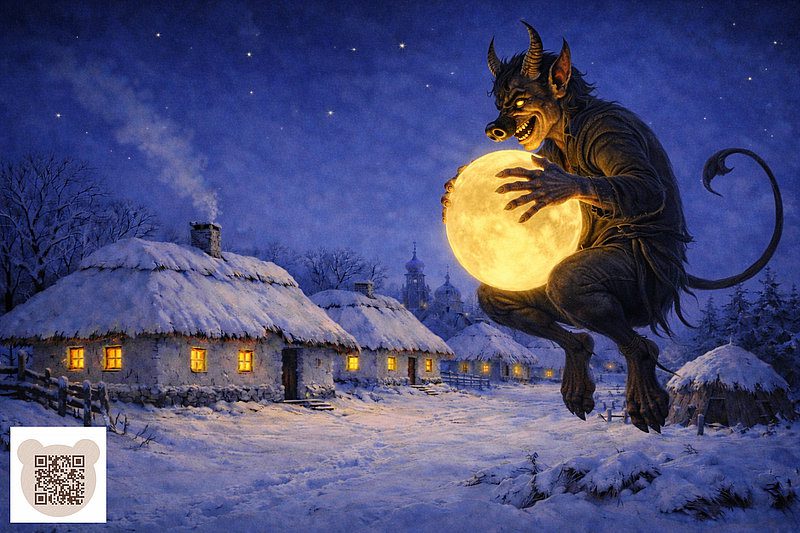
That winter wrapped Dikanka so generously, as though Mother Nature herself had decided to hide the whitewashed cottages beneath soft, feathered quilts. The snow lay so white, so spotless, that it dazzled the eyes even at night. Bluish smoke curled from the chimneys—every stove was already warming festive kutya with poppy seeds and walnuts, and beneath the eaves drifted the scents of dried apples and fresh hay. It seemed the whole village stood frozen, waiting for the first star. But up in the heavens that night, something was amiss.
Along the very edge of a cloud, limping on his little hooves and twisting his crafty snout in every direction, crept the Devil. Yes, that very one—with a narrow muzzle and a long tail, which he kept wrapping around himself to keep from freezing. The horned scamp was in a foul mood: he dearly wished to play a prank on the people, and such a prank as would spoil their holiday merrymaking entirely.
“Look at it gleam like a polished copper basin!” the Devil grumbled, squinting at the plump, bright-yellow moon.
He leapt up, scorched his fingers on the moon’s side, blew on them, and then—snap!—snatched the moon deftly with both paws. He stuffed it into his deep pocket, fastened the button, and grunted with satisfaction. At that very instant, Dikanka sank into a darkness thick as pitch.
“There’s your holiday! Now even that blacksmith Vakula won’t find his way to his pretty Oksana, and no godfather will make it to his neighbour’s for dumplings!” the Devil cackled, rubbing his paws.
But he had forgotten one important thing. In Dikanka lived people who believed that even if the moon went missing, the sky was still full of stars. And if it grew truly dark, every person had a heart inside them to lead the way—home, or to a friend’s house, or even to the tavern.
Part 2: The Blacksmith Vakula
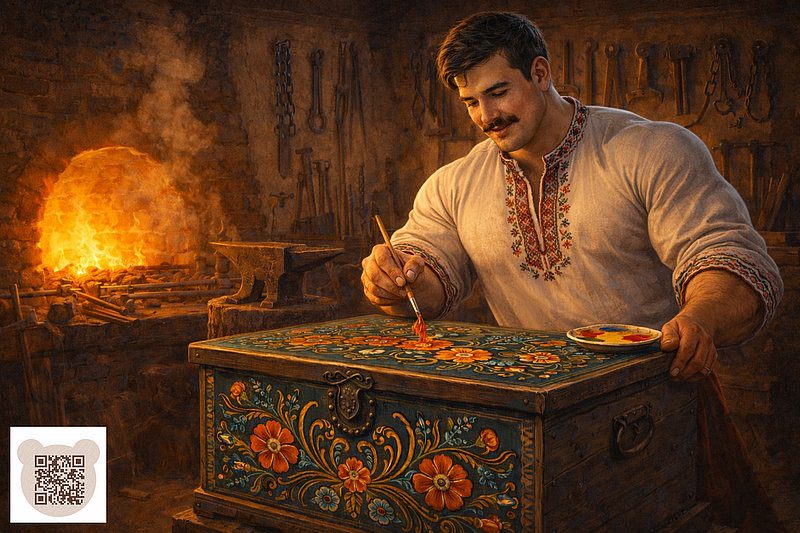
While the Devil hopped about the clouds, rejoicing in the darkness, a window at the very edge of Dikanka shone brightly—the forge. Vakula was at work there. Had you seen him, you would have known at once: here stood a true bogatyr! His shoulders were as broad as gateposts, and his hands so strong he could bend a horseshoe as though it were made of soft wax. Yet fear not his strength—no kinder man could be found in all the Poltava countryside.
Vakula was no mere blacksmith who spent his days pounding a heavy hammer on an anvil. He was a true artist. When the forge grew quiet, he took up brushes and paints. His painted chests were known in every nearby village: golden roses bloomed upon them, strange blue birds sang, and scarlet clusters of viburnum ripened. Even the walls of his own cottage he had adorned with such merry Cossacks that passersby could not help but smile at the sight.
That evening Vakula put on his festive embroidered shirt, stitched with an intricate red pattern. His heart beat louder than any hammer, for he was head over heels in love with the beauty Oksana.
“Ah,” sighed Vakula, straightening his sash, “for such a marvel as Oksana, even the stars of heaven are too few! I long to give her something for Christmas that no one else in the world possesses. Something she’ll look at and know how dearly I love her.”
Part 3: The Capricious Beauty
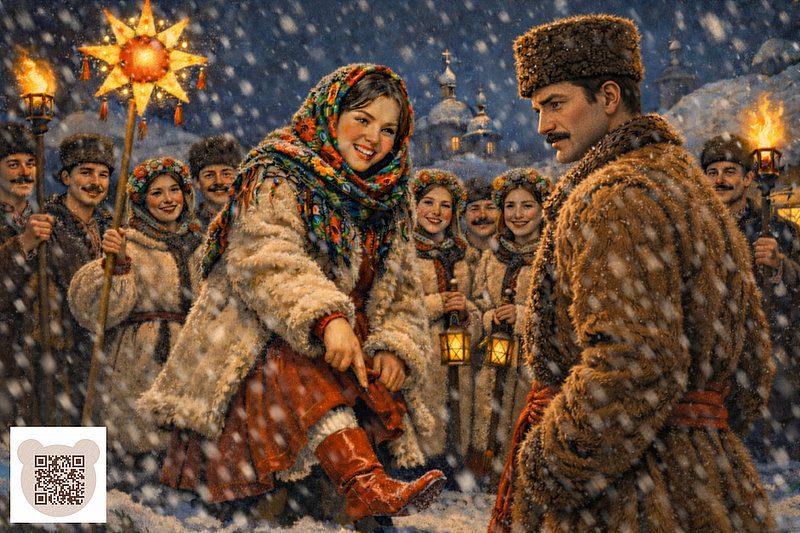
The Devil’s darkness was no help to him at all! As soon as evening fell, Dikanka came alive, ringing and glowing with light. Carolers poured into the streets. Everywhere flashed bright ribbons, painted masks from the puppet plays, and—chief among the guests—a great golden Star on a pole, shining brighter than all the missing moons.
“Carol, carol, caroler!” rang out here and there.
Boys and girls jingled their little bells, their sacks growing heavy with honey cakes, nuts, and ringing coins. The laughter was so loud that even the Devil in the sky had to clap his paws over his ears!
Vakula found Oksana by her cottage. She stood among her friends, cheeks rosy from the frost, admiring her reflection in a small mirror.
“Look at me, Vakula,” she said slyly, narrowing her eyes. “See how fine I am! Pretty, am I not? Oh, very pretty! Everyone says you are the best craftsman, Vakula. But what are your chests to me? If only you would bring me real golden slippers—the kind the Empress herself wears—then I would believe you’d do anything for my sake!”
Her friends burst into laughter, and Oksana tossed her head proudly. She meant it as a jest, to tease the blacksmith, but Vakula did not smile. His kind heart stood still: to him, the mockery of his beloved was like a sharp knife.
“You shall have your slippers, Oksana!” he said firmly. “And they will be the finest in the world, of pure gold. And if I cannot obtain them, I shall perish in the wide world! Farewell, Oksana, should we never meet again!”
He turned and strode away, while Oksana fell silent in surprise. She felt awkward and a little frightened: she had only wanted to boast before the girls how she could manage the heroic blacksmith—how with her he became as obedient as a babe. But Vakula had taken her whim in earnest and seemed truly hurt. What if he was so offended that he would never return?
Part 4: Riding the Devil
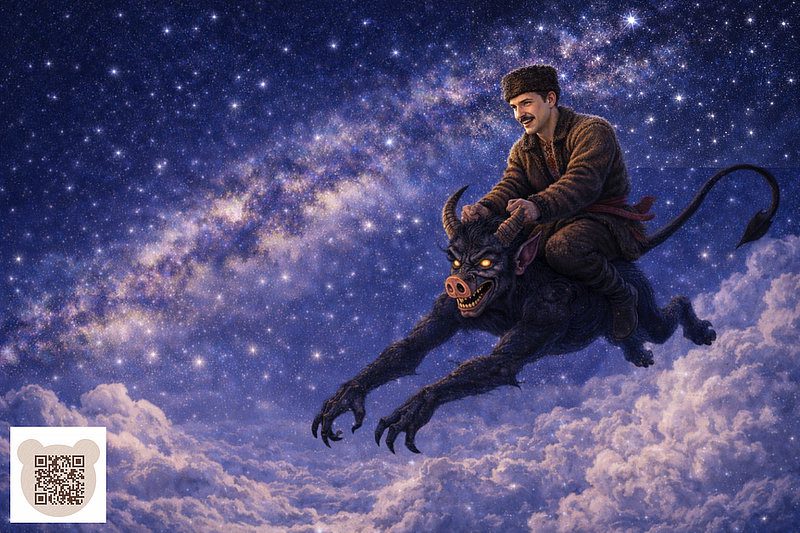
Vakula walked along the snow-covered road, pondering how he might procure the Empress’s slippers, when suddenly, straight from a snowdrift, leapt out our old acquaintance—the Devil. The tailed trickster decided this was his chance to confuse the blacksmith utterly and lure him to his side. How he would boast to the chief Devil of having ruined the soul of a devout craftsman!
He began to hop about, pull faces, and whisper foolishness, hoping to frighten Vakula. But the blacksmith of Dikanka was no timid sort! In an instant he guessed that before him stood the very thief who had stolen the moon from the sky. As nimbly as he was used to gripping red-hot iron with tongs, Vakula seized the Devil by his long tail.
“Caught you, you scoundrel!” Vakula laughed. “Since you’re so quick and know how to fly beneath the clouds, you’ll serve me now. Carry me at once to where the lights of the great city shine, straight to the Empress herself! And don’t you dare play tricks, or I’ll shoe you so smartly you won’t be able to fly—nor even hop!”
The Devil, unprepared for such agility from Vakula, fell silent and shrank back, but there was nothing for it—he had to obey.
They soared aloft, leaving the sleepy cottages of Dikanka far below. Vakula flew through the frosty air, and above him spread the bottomless sky, brimming with stars. Straight ahead stretched the Chumak Road, as though silver flour had been scattered across black velvet. The stars tinkled like tiny crystal bells. The winter night shone so brightly that Vakula felt himself part of a great heavenly embroidery.
Part 5: The Golden Slippers
Vakula’s journey ended swiftly. He had scarcely finished admiring the stars when he found himself standing in a vast, light-filled hall, alive with merriment. All the court ladies and gentlemen stared in wonder: whence came this simple yet stately blacksmith in an embroidered shirt?
Vakula did not lose his wits. He told the Empress of the maiden Oksana who lived in faraway Dikanka, and of how the capricious beauty had demanded the Empress’s own slippers. Amused by his boldness, the Empress ordered that he be given the finest, most precious golden slippers to be found in her palace.
The return journey was quicker still. In the blink of an eye, Vakula was back in snowbound Dikanka. He hurried toward Oksana’s house, clutching the precious gift so tightly that he had to hold onto his cap, lest it be whisked into the snow and lost forever.
But what was this? Oksana sat by the window, her beautiful eyes full of tears. She herself now regretted her foolish whim.
“I don’t need your slippers, Vakula,” she whispered, when the blacksmith offered her the gift. “You are dear to me even without them.”
Vakula smiled and drew the maiden close. And Oksana, that capricious beauty, laughed and shed tears of happiness.
At that very moment, it grew light outside once more. The Devil, seeing that his prank had failed and all were reconciled, flung the moon from his pocket in vexation, and it returned to its rightful place in the sky.
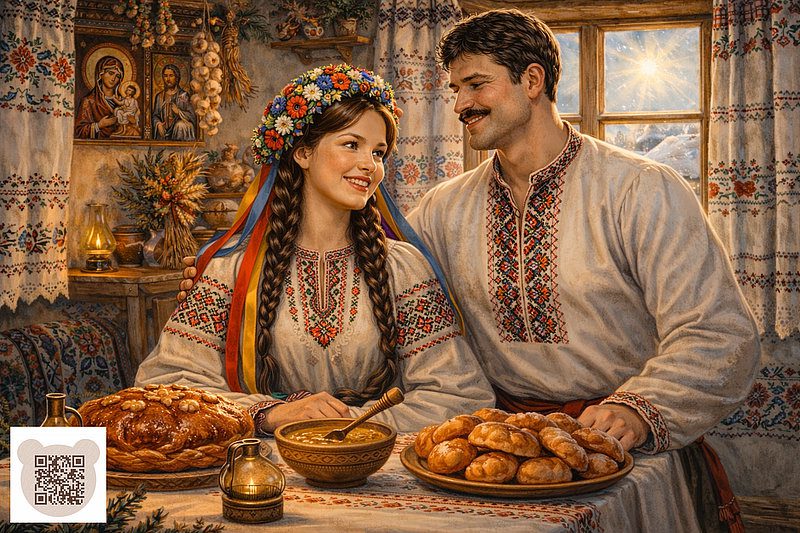
Oksana’s family was already awaiting guests. A great bowl of kutya with poppy seeds and honey stood on the table, candles burned brightly. The whole village gathered to greet the feast. Vakula and Oksana sat side by side.
The slippers, though golden, remained standing in the corner: for it turned out that love is the treasure dearer than all wonders in the world.
Support the creation of new fairy tales for children! ❤️


Discussion Plan After the Tale “The Night Before Christmas”
- Step 1. Entering the Conversation
Goal: to help the child recall the story and prepare for dialogue.
What was this tale about?
Who did you like most?
Which moment was the most interesting or the funniest?
- Step 2. Understanding the Characters
Goal: to learn to recognize feelings and actions.
Was Vakula kind or unkind? Why?
How did Vakula feel when Oksana asked for the slippers?
Why did Oksana behave capriciously at first?
How did she feel at the end of the tale?
(You may prompt: happy, sad, offended, regretful.)
- Step 3. Cause and Effect
Goal: to understand that actions have consequences.
What happened because Oksana joked?
Was it easy for Vakula?
What changed when Oksana said that Vakula himself was what mattered?
- Step 4. The Main Idea of the Tale
Goal: to reinforce the meaning.
What proved most valuable in the tale—the slippers or love?
Can love be bought with gold?
How should we treat those who love us?
Creative Task After the Discussion
“The Caroler’s Star.” Cut a star from yellow paper and glue it to a stick (a chopstick or pencil will do). Let the child decorate and color it themselves.
With this star, you can go “caroling” from room to room, wishing everyone in the household good health. It’s a splendid idea to visit a grandmother, friends, or neighbors together as a family.
Historical Note: Stars, Kutya, and Dikanka
Nikolai Gogol’s story is filled with the living traditions and daily life of Ukraine in centuries past. To make this tale-truth clearer, let us glance into the history of those times.
- Did Dikanka really exist?
Yes, Dikanka is a real and very picturesque village in the Poltava region of Ukraine. In the nineteenth century it was famed for its dense oak forests and handsome estates. Gogol often visited these parts and described them with great affection, blending real landscapes with folk legends.
- Who were the carolers, and why did they carry a Star?
Caroling was an ancient ritual celebrating Christmas. Groups of children and youths went from cottage to cottage, singing carols—songs wishing the хозяева health and a rich harvest. At the head of the group always walked the “star-bearer,” carrying a large eight-pointed star on a pole. It symbolized the Star of Bethlehem that showed the way to the light.
- What is kutya, and why is it so important?
Kutya is the chief dish of the Christmas table. It is a porridge of wheat with honey, poppy seeds, and nuts. Each ingredient carried meaning: grain symbolized eternal life, honey—joy, and poppy seeds—abundance and the starry sky. It was believed that the tastier the kutya, the luckier the coming year would be.
- The Painted Chest—why was it so valuable?
For a Ukrainian girl of the nineteenth century, a chest (skrynia) was her greatest treasure. It held her dowry: embroidered shirts, ritual towels, and ornaments. Chests were often commissioned from the finest craftsmen, like our Vakula. They were called “painted” because they were adorned with bright colors—flowers, birds, and fairy-tale beasts.
- The Slippers—the height of dreams?
These were elegant women’s shoes with heels and pointed toes. For a girl of Dikanka, who usually wore simple leather footwear or boots, gold-embroidered slippers from the city were a symbol of true fairy-tale wealth.
- The Chumak Road—where did the name come from?
The cluster of stars, flung like a bright ribbon across the sky, had long been called in Ukraine the Chumak Road. According to legend, the chumaks—traders who hauled salt from Crimea—once scattered salt from their wagons across the heavens so they might always find their way home. It is along this very “salty road” that our Vakula flies in the tale.