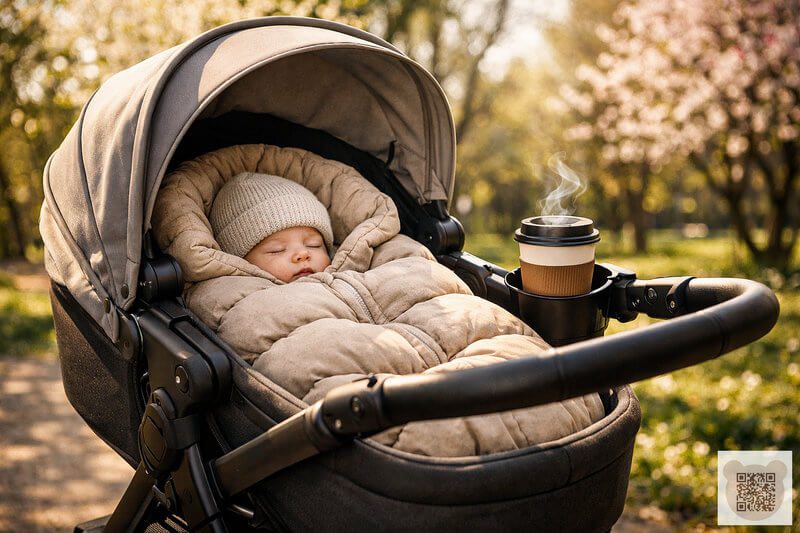
A first spring walk with a newborn isn’t some filtered social-media aesthetic where you, in a beige trench, glide elegantly behind a stroller toward the sunset. In real life, it’s a high-stakes guessing game with the weather—one minute it’s May, the next it’s October—and you’re frantically jamming a finger under the baby’s collar every five minutes. Spring is sneaky: the sun is bright, but the breeze is chilly. Let’s figure out how to do this right so you don’t come home with a hiccuping, ice-cold bundle instead of a rosy-cheeked angel.
When should we launch Operation “First Public Outing”?
Timing: from “out-and-back” to a full-on marathon
Don’t try to cover the whole neighborhood on day one. How long should you walk at the start? Exactly as long as it takes to brew a cup of coffee.
- Day 1: 15 minutes around the block. A test run for the lungs.
- Days 2–7: add 10 minutes each day until you reach that golden hour.
If it suddenly feels like early summer, feel free to push it and stay out longer. But if “spring” today means 35°F (+2°C) and slushy snow, short little dashes are the way to go.
Expert Insight. As an educator, I often see moms trying to create sterile silence inside the stroller. But spring sounds—dripping meltwater, birdsong, the soft rustle of wind—are the best sensory workout for your baby’s brain. Don’t be afraid to keep the canopy open!
Wardrobe horror: the “+1 layer” rule
- A cotton layer (onesie or sleeper).
- A fleece layer (if it’s below 50°F / +10°C outside).
- A mid-weight bunting or pram suit (no heavy sheepskin in April, I’m begging you!).
Stroller etiquette and wind protection
Cheat-sheet table “The Spring Thermometer”
| Celsius (°C) | Fahrenheit (°F) | What do we put on the little one? | The secret ingredient |
|---|---|---|---|
| 0°C — +5°C (Winter is putting up a fight) |
32°F — 41°F (Winter is hanging on) |
Cotton sleeper + fleece layer + mid-weight bunting (150–200g) | A thick stroller blanket |
| +5°C — +10°C (Classic spring) |
41°F — 50°F (Typical spring) |
Cotton sleeper + mid-weight bunting + knit beanie | Mom’s coffee thermos |
| +10°C — +15°C (Almost May) |
50°F — 59°F (Warm spring vibes) |
Cotton bodysuit + thick velour or quilted cotton romper | A stroller sunshade |
Expert Insight. A note about the spring sun: it’s already strong, and a baby’s skin is thinner than tissue paper. If you’re out longer than 30 minutes, use a sunshade on the stroller. And if their cheeks turn pale or your little one becomes suspiciously quiet and sluggish—that’s your cue to head home and warm up immediately, without waiting to finish your “scheduled” time.
Support the creation of new fairy tales for children! ❤️


Spring shopping: what to buy so you’re not walking “for nothing”
- A silicone rain cover with a window. Use this only during a downpour! Otherwise, it’s a “greenhouse” where your baby can’t breathe.
- A stroller muff for Mom. Spring wind is merciless to your manicure and the skin on your hands.
- A stroller organizer bag. In spring, the weather changes every 15 minutes; your bag should always hold a spare dry diaper and a light blanket.
FAQ: Addressing “Mom” Fears and Myths
- What if their nose is cold?
- Which stroller is best for the first walk?
In spring, your main enemy is slush—that messy mix of snow and mud. Look for an “all-terrain” stroller with large inflatable wheels. Tiny city wheels will get stuck in the first spring puddle, and your walk will turn into an unplanned strength-training session.
- Do you need a pacifier on a walk?
Checklist: “Before You Head Out”
- Is Mom dressed? (You dress first, then the baby. That’s the law—otherwise, you’ll be sweating in the hallway before you even open the door).
- Phone charged? (For those Instagram Reels and emergency calls to your husband).
- Weather-protection cream? (Apply to their cheeks 20 minutes before you leave so it has time to absorb and doesn’t turn into an icy crust).