This collection of mini fairy tales about the cat was created to help your child learn to think, understand, retell, and reason. This is the foundation for developing coherent speech, attentiveness, and school readiness. Moreover, these fairy tales are so simple and sweet that one day your little one will want to tell one to Dad or Grandma before bed. Can you imagine? Just like a grown-up!
The kitten and the puppy Bimka
Meaning: Teaching acceptance and friendship between children with different personalities.
Skills: Emotional intelligence, listening, retelling.




A parakeet named Chika lived on the owner’s windowsill. He talked all day long:
“Hello! Hello! How are you? Hello!”
And the kitten Murchik just flicked his tail:
“My ears hurt from your chatter…”
But one day the owner left, and the house became very, very quiet.
Murchik sat and yawned, and suddenly Chika squeaked:
“Hey! Murchik! Where are you? Let’s be friends!”
Murchik came closer, looked: Chika was sitting there with his fluffy crest and looking sadly.
“Well, alright…” — said the kitten. — “Sing me your little song.”
And Chika sang.
And Murchik wasn’t bored at all anymore.
Since then, the kitten listened and Chika sang — and they were both very happy.
Questions and tasks for speech and comprehension development
Here are questions for the fairy tale “The kitten and the parakeet Chika” for children ages 3–6 to help develop memory, speech, and retelling skills:
- Who are Murchik and Chika?
- What did the parakeet Chika love to do?
- What did Murchik feel when Chika talked all the time?
- What happened when the owner left?
- How did Chika call out to Murchik?
- Why did Murchik come up to Chika?
- What did the parakeet do to make friends with the kitten?
- What did Murchik feel when Chika started to sing?
- How did they start spending time together?
- Why do you think the kitten stopped being bothered by Chika’s chatter?
Tasks:
- Retell the fairy tale in your own words.
- What did you remember the most?
- Come up with different names for the kitten and the parakeet.
- Have you ever felt bored? What did you do?
Ask the child to draw Murchik listening to Chika, or come up with what they will do tomorrow. This trains imagination and develops emotional perception.
The kitten and the turtle Tosha
This fairy tale helps a child understand that it’s not always necessary to rush. Sometimes it’s important to just be, observe, and feel. It develops mindfulness and teaches calmness. The fairy tale teaches how to appreciate different life rhythms of friends.

In the yard lived a turtle named Tosha. She moved so slowly that the kitten Murchik once had time to go get milk and come back, and Tosha was still walking to the flowerbed.
“What a bore,” — sighed Murchik and lay down next to her.
But then he noticed: how the grass rustled, how a bug crawled, how a butterfly landed on a leaf.
And Tosha kept crawling and crawling — and didn’t miss a thing.
Murchik closed his eyes and thought:
“It’s nice when you don’t have to rush anywhere…”
Since then, he often came to Tosha and spent half the day just sitting next to her, listening to the wind and warming himself in the sun.
And he really liked it.
Questions and tasks for speech and comprehension development
Questions for the fairy tale “The kitten and the turtle Tosha” to help children ages 3–6 easily retell and discuss the story:
- Who is Tosha?
- Why did Murchik think it was boring with Tosha?
- What did the kitten start to notice when he slowed down?
- Why did he start coming to Tosha again and again?
- What do you think Tosha felt being next to Murchik?
- What new thing did Murchik understand thanks to Tosha?
Tasks:
- Retell the fairy tale in your own words.
- What did you remember the most?
- Come up with a new name for the turtle.
- Look out the window or go outside — what do you see, hear, and feel if you just sit quietly?
- Draw Tosha and Murchik sitting in the sun.
After reading, you can offer the child a “quiet observation”: sit for a couple of minutes, listening to the sounds around. Discuss what they noticed. Such exercises develop attention, reduce anxiety, and strengthen emotional balance.
These questions help children notice important details, understand the characters’ mood, and learn to see the value in different life rhythms.
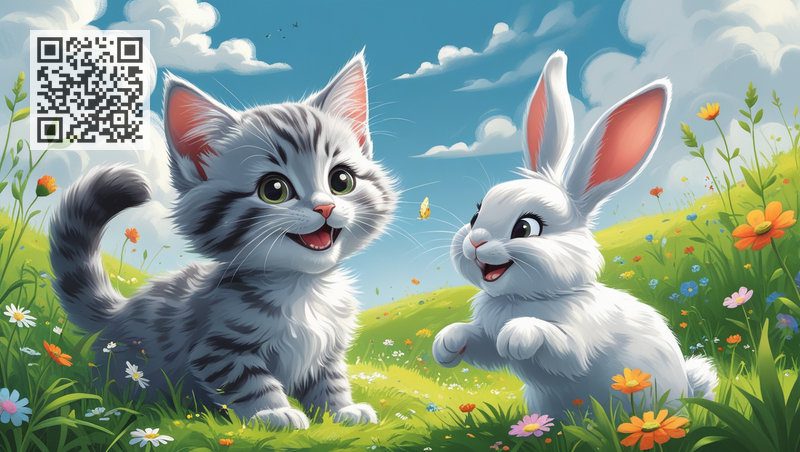
The kitten and the rabbit Pushok
Meaning of the fairy tale: about friendship, acceptance, and the ability to play for joy, not for victory. This story helps children understand that in play, it’s not winning that matters, but fun, laughter, and friendship. It teaches flexibility, the ability to compromise, and letting go of the desire to always be first.
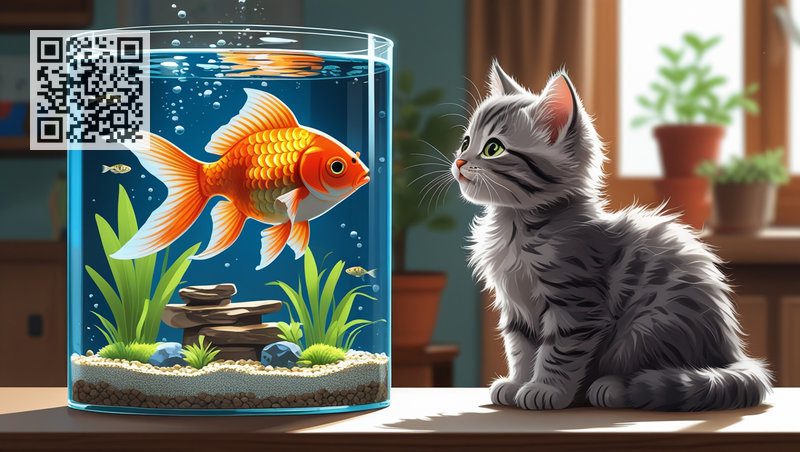
Once upon a time, there lived a kitten named Murchik. And he had a big interest — the aquarium! And in it swam a goldfish named Lyalya.
“What a shiny one!” — whispered Murchik as he crept closer.
One day he got so close that his whiskers touched the water.
But Lyalya wasn’t scared. She swam up, let out a bubble — bloop! — and winked.
Murchik froze.
“She’s alive… and brave!”
He gently sat down nearby and stayed very, very quiet, like a cushion on the couch. And he came back every day — just to sit and purr.
Now he knew:
“If someone is small and delicate, you shouldn’t scare them. You should take care of them.”
Questions and tasks for speech and comprehension development
Questions for the fairy tale “The kitten and the goldfish Lyalya” for children ages 3–6 to help retell and discuss the story:
*To explain a new term to the child. The main character is the one who is talked about the most in the fairy tale.
- Who were the main characters* of the fairy tale?
- What attracted Murchik in the aquarium?
- How did he behave at first?
- How did the goldfish Lyalya react?
- What surprised Murchik about the fish’s behavior?
- What did the kitten realize when the fish swam up?
- Why did Murchik start behaving differently?
- Why do you think it’s important to take care of those who are smaller?
Tasks:
- Retell the fairy tale in your own words.
- Draw Murchik and Lyalya by the aquarium.
- Come up with other ways Murchik could take care of the fish.
- Think of a different name for Lyalya.
- Remember a time when you helped or took care of someone small.
Discuss with the child why it’s important to be gentle and kind with animals. Ask them to recall times they acted carefully — this builds confidence and empathy. You can use the fairy tale as a reason to talk about caring for pets.
These questions and tasks for the fairy tale about the kitten help children develop empathy, attention to detail, and retelling skills.
The kitten and the little goat Zefirka
Meaning of the fairy tale: about accepting differences and respecting other customs. The fairy tale helps children understand that everyone can have their own habits and traditions — and that doesn’t get in the way of friendship. A story about mutual understanding, openness to new things, and flexibility in communication.
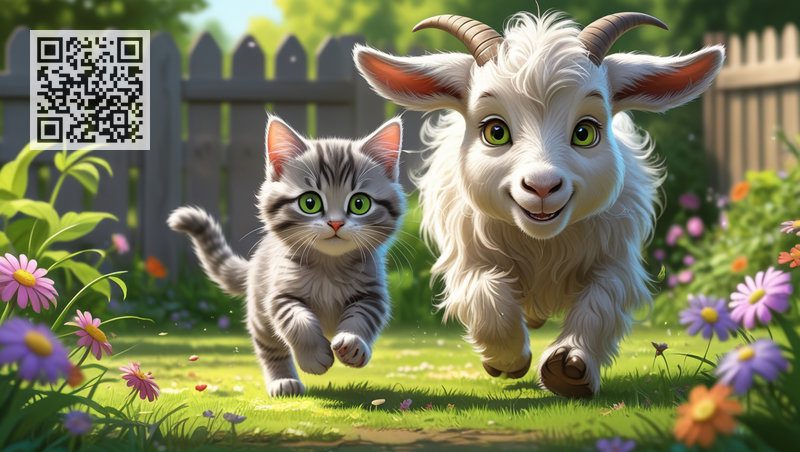
At Grandma’s country house, the kitten Murchik stepped out onto the lawn — sunshine, bees, flowers… beautiful!
And suddenly — bonk! — someone butted him in the side.
“Hey!” — meowed Murchik.
“I didn’t mean anything bad,” — laughed the little goat. — “I’m Zefirka! That’s how we say hello.”
At first, Murchik squinted:
“You’ve got some strange customs here on the lawn…”
But then they ran together, jumped over bumps, and even nibbled on grass (Murchik — only pretending).
“You’re amazing, Zefirka!” — said the kitten.
“And so are you, Murchik. You purr instead of butting — that’s interesting too!”
That’s how they became friends: each in their own way, but — together.
Questions and tasks for speech and comprehension development
Here are questions for the fairy tale “The kitten and the little goat Zefirka” for children ages 4–6 — they help better understand the plot and practice retelling:
- Where did Murchik go?
- Who butted the kitten on the lawn?
- Why did the little goat Zefirka do that?
- How did Murchik react?
- What did Murchik and Zefirka start doing together?
- Did the kitten nibble on the grass for real?
- Why did they become friends even though they were different?
- What did Zefirka say about Murchik?
- And what did Murchik say about Zefirka?
- Can you be friends if your habits are completely different? Why?
Tasks:
- Act out the story using any toys.
- Draw Murchik and Zefirka being friends.
- Come up with what happened next.
- Compare Murchik and Zefirka: how are they alike? How are they different? Why did they become friends?
These questions and tasks for the educational fairy tale about the kitten help a child learn to listen attentively, retell, and reflect on how important it is to respect differences in friendship.
The kitten and the piglet Sonya
Meaning of the fairy tale: about accepting those who are different from us. The fairy tale helps a child understand that “strange” doesn’t mean “bad.” Sometimes behind the noise and differences are kindness, generosity, and true warmth. The story teaches not to judge by first impressions and to be open to friendship.
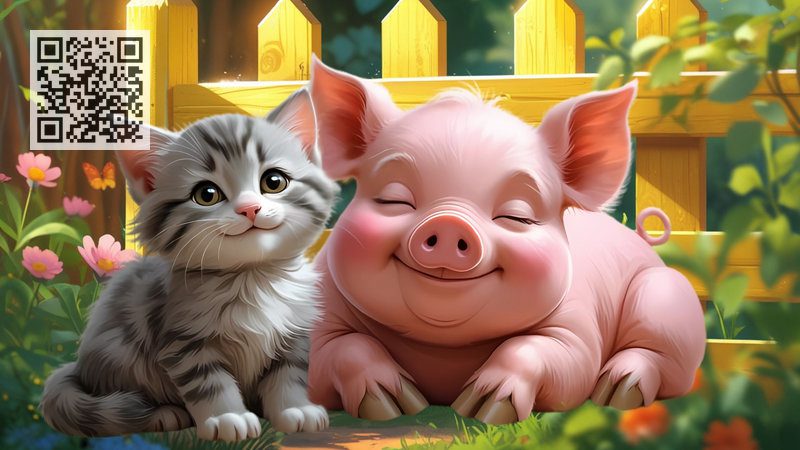
A piglet named Sonya moved in next door — pink, round, and very noisy.
“Snrrr-oink!” — she squealed from morning to evening and dug in the dirt like an excavator.
Murchik looked out the window and wrinkled his nose:
“Pff! How strange…”
But one day Sonya came up to the fence, handed him an apple, and said:
“Here you go, fluffball! It fell from the tree — we have to share!”
Then she flopped onto her side and showed her soft, warm belly.
Murchik gently touched it with his paw — and suddenly started purring.
“Strange, but nice!”
Since then, they were always together: he purred, and she oinked — and both had fun.
Questions and tasks for speech and comprehension development
Questions for the fairy tale “The kitten and the piglet Sonya” for children ages 4–6 help practice retelling and better understand the meaning of the story:
- Who is Sonya?
- How did the piglet behave? What did she do all day?
- Why did Murchik think Sonya was strange at first?
- What did Sonya bring Murchik one day?
- How did Sonya show that she wanted to be friends?
- What did Murchik do when he touched Sonya?
- What did he think about her?
- How did they spend time together after that?
- Why is it important to accept friends as they are?
- Would you like to be friends with someone noisy like Sonya? Why?
Tasks:
- Retell the fairy tale in your own words.
- Draw the piglet Sonya and the kitten Murchik together.
- Come up with what else might have fallen from the tree besides the apple.
- Think of a different name for the piglet.
- Think: do you have friends who seem a little “noisy”? How do you talk and play with them?
Talk with your child about how important it is not to jump to conclusions too quickly. Sometimes behind “unusual” behavior are the kindest and most sincere intentions. Discuss how important it is to share and be friendly even with those who may seem strange or confusing at first.
These questions and tasks for the mini fairy tale about the kitten and the piglet help develop a child’s attention, empathy, and storytelling skills.
The kitten and the little mouse Shurshik
Meaning of the fairy tale: about acceptance and lack of prejudice. The story teaches children that appearance, fear, or different roles (in fairy tales, cats hunt mice) don’t prevent real friendship. Even if someone is different or shy — you can still become friends and have fun together.

In the old shed, the kitten Murchik once heard: rustle-rustle-rustle…
“Who’s there?” — he asked, lifting his whiskers.
From behind a sack, a tiny mouse popped out and immediately trembled like a leaf.
“Don’t eat me, please! I’m small… and dusty!”
Murchik sat down and gently purred:
“I’m not a hunter. I’m just out for a walk. What about you?”
“Hiding,” — squeaked the little mouse. — “Everyone’s afraid of me. And I’m afraid of everyone too.”
“Hey, want to play hide-and-seek together? You’re a master at it, I know!”
Since then, in the old shed, you could often hear:
Rustle-rustle! Meow! I found you!
Murchik and Shurshik — so different, yet such strong friends.
Questions and tasks for speech and comprehension development
Questions for the mini fairy tale “The kitten and the little mouse Shurshik” for children ages 3–6 to help retell and reflect on the story:
- Where did the kitten Murchik live?
- What did he hear in the old shed?
- Who popped out from behind the sack?
- Why was the little mouse scared?
- What did Murchik say to calm Shurshik down?
- Why was the little mouse hiding?
- What did the kitten suggest to Shurshik?
- What game did they start playing together?
- Why did Murchik and Shurshik become friends even though they were so different?
- Have you ever been friends with someone who was afraid of you at first? What did you do?
Tasks:
- Retell the fairy tale from memory.
- Draw the kitten and the mouse playing hide-and-seek.
- Come up with a different name for the mouse.
- Imagine where else the little mouse could hide.
- Tell about someone you like playing hide-and-seek with. And if you were a little mouse — where would you hide?
Talk with your child about the importance of being kind to those who are smaller or weaker. Remind them that fear is a normal feeling, and that kind words and friendliness can help it go away. Play hide-and-seek together — it’s a great way to build attention and emotional connection.
These questions and tasks for the fairy tale about the kitten help the child not only retell the story, but also reflect on kindness, courage, and accepting others.
The kitten and the old cat Musya
Meaning of the fairy tale: about care, sensitivity, and respect for elders. The story teaches children empathy and attentiveness toward those who are older and weaker. Sometimes care is shown not through actions, but simply through warm presence.
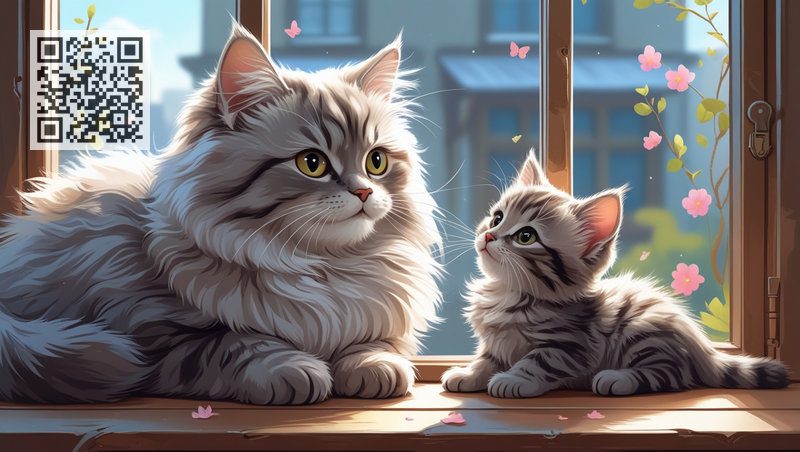
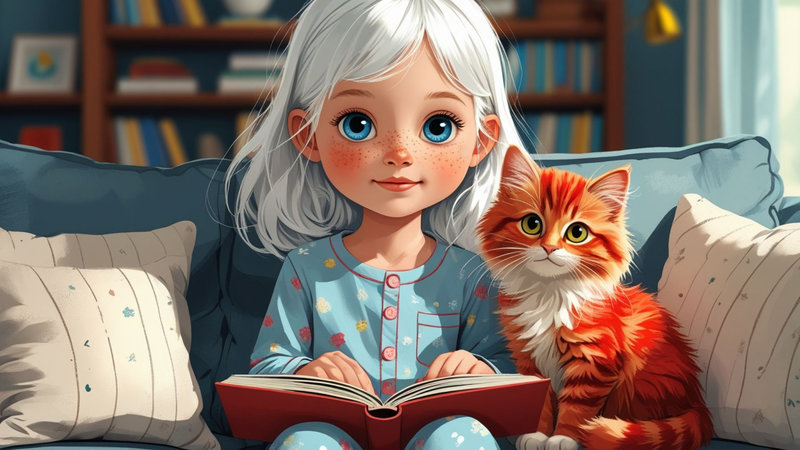
Who do you see in this picture? What are they doing?
In the house, besides Murchik, there lived another cat — old Musya.
She hardly ever played, always slept on the windowsill, and purred something very, very quietly to herself.
“She’s boring,” thought Murchik. “No racing, no jumping…”
But one morning Musya didn’t come to breakfast. She lay curled up in a ball, barely breathing.
Murchik got scared. He came closer, gently lay down beside her, and began to warm her with his soft, warm side.
He stayed like that the whole day, forgetting all about his mischief.
And in the morning, Musya opened her eyes and smiled a cat’s smile.
“Thank you, Murchik. You’re not just a cat now — you’re a caring cat!”
Since then, he always listened to her purring — it was full of wisdom.
Questions and tasks for speech and comprehension development
Questions for the fairy tale “The kitten and the old cat Musya” for children ages 3–6 help retell the story and discuss its meaning:
- Who is Musya?
- How was Musya different from Murchik?
- Why did Murchik think she was boring?
- What happened to Musya one morning?
- How did Murchik act when he realized Musya was sick?
- Why did Murchik forget about his mischief?
- How did Musya thank him?
- What did Murchik understand after that?
- Why is it important to care for others?
- What do you think Musya could teach Murchik?
Tasks:
- Retell the fairy tale in your own words.
- Draw Murchik lying next to Musya.
- Think of what might happen next: maybe Musya taught Murchik something important?
- Tell about a time when you took care of someone — your grandma, mom, a toy, or even a kitten.
- Imagine Musya started telling fairy tales to Murchik. Make up one of them.
This little fairy tale about the kitten is a reason to talk about how old age and calmness are not weakness, but wisdom. Explain to the child that it’s not always necessary to play and run to be important and needed. Your support in moments of empathy is the key to nurturing kindness in a child.
These questions and tasks teach children to be attentive to the elderly, develop compassion, and help them learn to retell with understanding.
The kitten and the lamb Kudryashka
Meaning of the fairy tale: about trust, patience, and respect for boundaries. This story helps a child understand that to become friends with someone shy or fearful, you need time, calmness, and kindness. True trust doesn’t appear instantly — it grows out of care and attention.
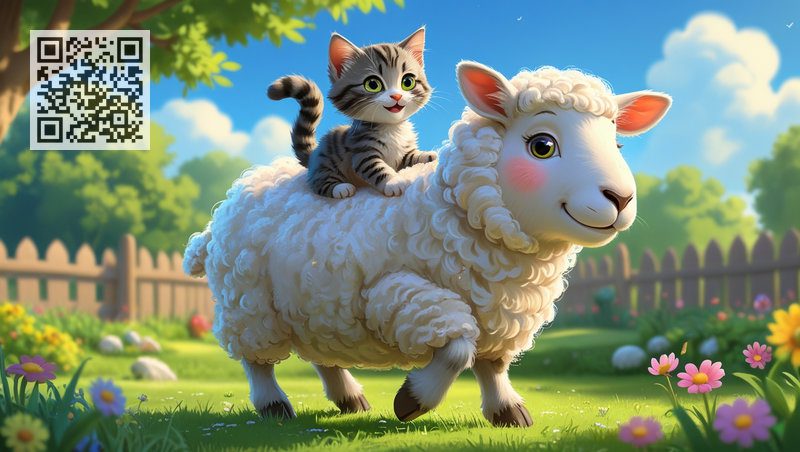
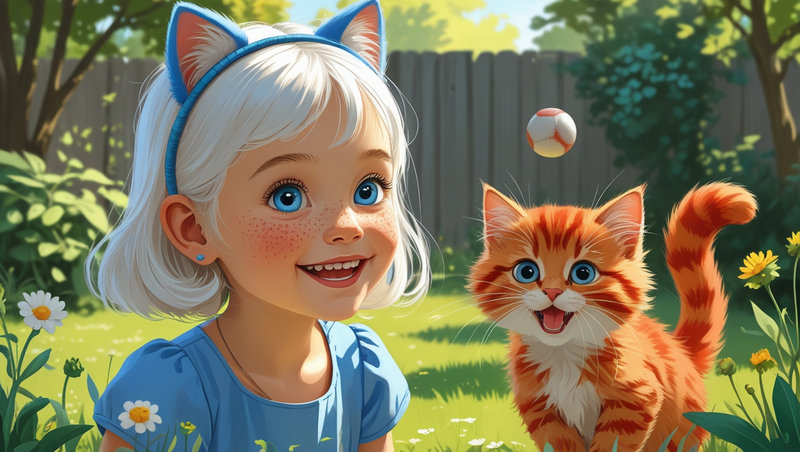
Who do you see in this picture? What are they doing?
In the summer, the kitten Murchik went to Grandma’s village. It had everything: daisies, a lawn, and even a sheep named Kudryashka.
But there was one problem — Kudryashka was shy. If she saw someone, she would press against the fence and tremble.
Murchik came closer — she flinched.
“Don’t be afraid,” — he whispered. — “I just want to sit.”
And he started coming every day, silently. He would sit nearby and warm himself in the sun.
A week passed — and suddenly Kudryashka came up to him on her own, nudged him in the side with her nose, and lay down next to him.
“Wow,” — thought Murchik. — “Trust isn’t earned with paws, but with patience.”
From then on, they walked around the lawn together, and the little striped kitten often napped in Kudryashka’s wool.
Questions and tasks for speech and comprehension development
Here are questions for the fairy tale “The kitten and the lamb Kudryashka” for children ages 4–6 — they help retell the plot and talk about trust and friendship:
- Where did Murchik go for the summer?
- Who is Kudryashka and what was she like?
- How did Kudryashka behave when she first met Murchik?
- Why didn’t Murchik try to scare her?
- What did Murchik do to avoid frightening Kudryashka?
- When did Kudryashka come up to Murchik?
- What did she do to show trust?
- How did Murchik understand that they had become friends?
- Why can’t trust be forced?
- How do you behave when someone is afraid of you?
Tasks:
- Retell the fairy tale in your own words.
- Draw Kudryashka and Murchik lying on the lawn.
- Come up with what they did afterward: maybe they picked daisies or hid from Grandma?
- Remember if you’ve ever met shy children or animals. How did you talk to them?
- Think of what could scare Kudryashka again, and how Murchik might comfort her.
This fairy tale about the kitten and his friend gently helps the child understand an important idea: everyone has the right to their own pace and boundaries. Friendship shouldn’t be rushed or demanded. Instead — offer support, quietness, and kind presence. Invite your child to practice “quiet communication” — just being nearby without distracting, like Murchik did.
These questions and tasks help develop patience, attentiveness, and kindness in the child.
Why read mini fairy tales about the cat with questions?
Dear parents, grandmothers, grandfathers, and educators!
This collection of mini fairy tales about the cat was created to help your child learn to think, understand, retell, and reason. This is the foundation for developing coherent speech, attentiveness, and school readiness.
Moreover, these fairy tales are so simple and sweet that your little one (first with your help, and later on their own) will want to tell one to Dad or Grandma before bed. Can you imagine? Just like a grown-up!
After each fairy tale — questions for understanding, as well as tasks, for example:
- “What did you remember?”
- “What happened first, and what happened next?”
- “Come up with your own continuation”
Spend 10–15 minutes a day (or every other day) developing listening and comprehension skills. Read and discuss no more than one fairy tale at a time. When your son or daughter starts school and easily joins the process of learning to read, you’ll say to yourself: “Many thanks for the fun and useful time spent with the Baby-bear Club website!”
Read the fairy tale expressively, look at the picture together, answer the questions, discuss. Return to each little fairy tale about the cat several times. Choose questions and tasks appropriate for your child: the younger the child, the more modest their experience discussing fairy tales, the simpler the first tasks should be, and the shorter the session should be. Also, give your child a chance to tell the story themselves — this is another key to developing thinking and speech.
Important! Do this in an environment where nothing will distract you or your child. Pay attention to how your little one feels: if they are tired, hungry, or sick, or if they are at the peak of a behavioral crisis, it’s better to wait for a better time.
VERY IMPORTANT! Dear adults!
Every child has their own pace and experience. If your little one struggles with something, that’s completely normal. Never compare them to the children of friends or moms at the playground. Gradually, with your gentle help and with my mini fairy tales about the cat, your little one will learn, succeed, and get ready for school.
And one more thing: to avoid triggering speech anxiety or discouraging discussion, never rush — be patient and understanding. In extreme cases — gently give a hint. And — value your child’s unique opinion, even if it differs from yours — that’s such a wonderful thing!
Be sure to return to this page again and again — first, your child will fall in love with the adorable characters (and so will you, I promise!). Second, you’ll reinforce skills using familiar material, giving your child a well-deserved sense of success. And success is the best motivator to learn with pride, joy, and love!
Friends, stay with the Baby-bear Club website, where an experienced educator posts educational articles and materials for early development and school preparation.