
The first winter walk with a newborn can frighten even those parents who have never feared the cold in their lives. Just yesterday the baby was warm and watched over by doctors, and today you are standing at the door with a pram, thinking: “Is it too soon? What if they freeze? What if I’m doing everything wrong?” Easy now. Winter is neither a sentence nor an exam in parental bravery. A newborn’s first walk is a gentle lesson in adaptation—not an examination, not a world record, and certainly not a chase for perfection.
When can you start walking with a newborn in winter?
When can you start walking with a newborn in winter?
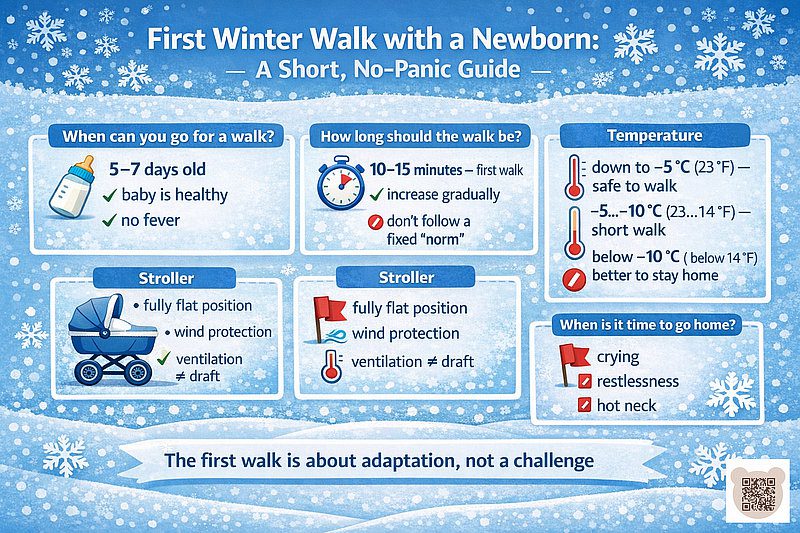
In most cases — on the 5th to 7th day of life, provided the baby is full-term and feeling well.
The first winter walk with a newborn requires no special preparation beyond plain common sense.
What matters:
- a normal body temperature;
- no signs of a cold;
- no individual restrictions from a doctor.
Waiting an entire month simply because “it’s winter” is excessive caution—one that more often feeds parental anxiety than truly helps the child.
How should you properly begin winter walks with a newborn?
How should you properly begin winter walks with a newborn?
In short: gradually and without heroics.
A newborn’s first winter walk should last 10–15 minutes. It is a first acquaintance with the air, not a full outing.
A sensible start looks like this:
- the first day — 10–15 minutes;
- then add 5–10 minutes each day;
- let the baby’s condition—not the calendar—be your guide.
Even if such a first walk feels far too short, that is perfectly normal: for a newborn’s adaptation, this amount of time is quite enough.
How do you go out for a walk with a newborn for the first time?
How do you go out for a walk with a newborn for the first time without returning home on the verge of an anxious breakdown?
The approach is simple:
- Dress the baby by the rule: what you wear, plus one extra layer.
- Make sure there are no drafts or exposed areas.
- Stay close to home and avoid long routes.
A newborn’s first walk is no time for experiments. If you feel tense, it is better to turn back early than to “push through.”
How long should you walk with an infant in winter?
How long should you walk with an infant in winter?
There is only one true answer: as long as the baby is comfortable.
Average guidelines:
- the first days — 10–20 minutes;
- after 1–2 weeks — 30–40 minutes;
- later — up to 1–1.5 hours in favorable weather.
If the infant sleeps peacefully, the walk was a success.
If they cry and grow restless, it’s time to go home—even if you “haven’t walked enough yet.”
At what temperature can you walk with a newborn in winter?
At what temperature can you walk with a newborn in winter?
General guidelines:
- up to –5 °C (23 °F) — no restrictions;
- –5 to –10 °C (23–14 °F) — short walks;
- below –10 °C (below 14 °F) — better to refrain.
It is important to remember that wind and dampness are often more dangerous than the frost itself. A newborn’s first winter walk should take place in calm weather, without strong winds.
Is it possible—or not—to walk with a newborn in winter?
Is it possible to walk with a newborn in winter?
Yes, it is both possible and necessary, if the baby is healthy.
Moreover, fresh winter air is often more beneficial than the dry, overheated air of an apartment. Problems arise not because of the cold, but because of:
- overheating;
- walks that are too long;
- ignoring the baby’s condition.
How should you walk with a newborn in a stroller during winter?

How should you walk with a newborn in a stroller during winter to keep it safe?
Pay attention to:
- a fully lying position;
- protection from the wind;
- proper ventilation.
During the walk, periodically check the baby’s back and neck.
A hot, damp nape is a sign of overheating—not of good health.
A baby’s first winter walk: common parental mistakes
A baby’s first winter walk often goes off plan because of simple mistakes:
- wrapping the baby too tightly;
- relying on advice from online forums;
- walking “through sheer willpower.”
Remember: in winter, it is easier to overheat a baby than to chill them.
When it’s better to postpone a winter walk
Sometimes the right choice is to stay at home:
- strong wind;
- a sudden drop in temperature;
- the baby is restless or feeding poorly.
This is not a failure and not a “broken routine.” It is sensible judgment.
Does a walk on the balcony replace going outside?
Many parents choose the balcony as a “trial” option—and this makes sense, with certain reservations.
A balcony walk can be an acceptable alternative in the first days or during poor weather, when going outside is truly undesirable. The baby gains access to cooler, fresher air, while parents gain calm and a sense of control.
However, it is important to understand: a balcony does not fully replace an outdoor walk. Outside, the air circulates more freely, humidity shifts, natural sounds and scents are present—all of this gently stimulates the baby’s nervous system and supports adaptation.
If you walk on the balcony:
- make sure it is well ventilated;
- avoid direct drafts;
- never leave the baby unattended.
A balcony is a reasonable compromise. But whenever possible, a calm walk outdoors remains the more beneficial and complete option for a newborn.
Conclusion
A newborn’s first winter walk is not a test of perfect parenting.
It is a calm process of adaptation, where the main guide is the baby—not parental fears.
If you stay attentive, take your time, and trust common sense, winter will not become a problem.
This material is for informational purposes only and does not replace medical advice.
If in doubt, consult a pediatrician.
Support the creation of new fairy tales for children! ❤️