How can we explain to a child who Jesus Christ is so that a spark of curiosity lights up in their eyes and draws them toward His life story? We often shy away from this subject, fearing that a kind tale might turn into a stern and tiresome lecture. But what if Christmas is, above all, a story of love, light, and hope? Discover a way to speak to children about the Feast of the Nativity in the language of the heart—engaging, sincere, and gentle enough for the very youngest. Stay with us on the site!
Why is it important to read this story to the very end?
A story about the Feast of the Nativity for children is a bridge between generations, a step into history, and a close, living acquaintance with Christianity. Here is what this tale will bring to your family:
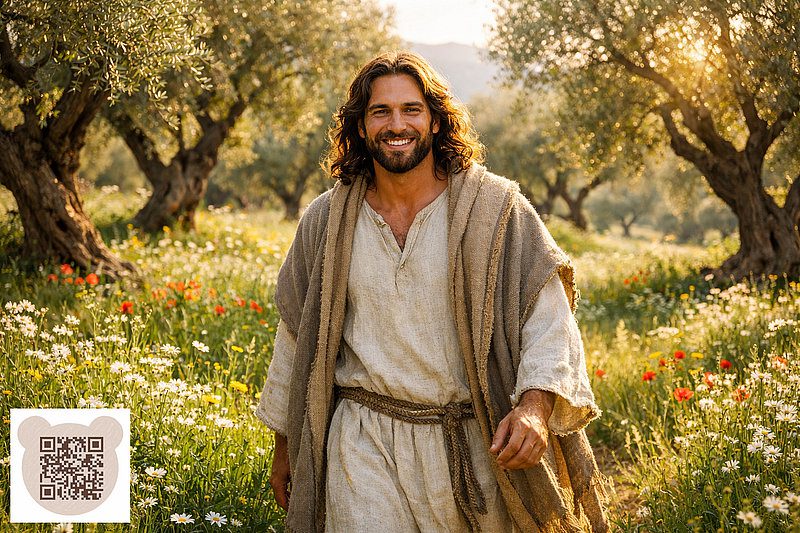
A living image of Jesus Christ. Your child will see Him not as a distant figure, but as a kind and merciful Man who treated children with immense love and tenderness.
A lesson in sincerity and warmth. The story of Jesus’ birth for children helps to develop emotional understanding: it teaches compassion, acceptance, and the truth that every person is endlessly precious.
Growth through curiosity. The story is shaped so that a child learns to listen, to ask meaningful questions, and to joyfully retell what they have heard.
A support for parents. You will have at hand a ready path for the calmest and coziest conversation about faith, meaning, and Christmas—free of doubt and heavy terms.
This story will fill your evening with light and help explain the greatest truths through what is simple and deeply human.
Who is Jesus, and why does His story matter today?
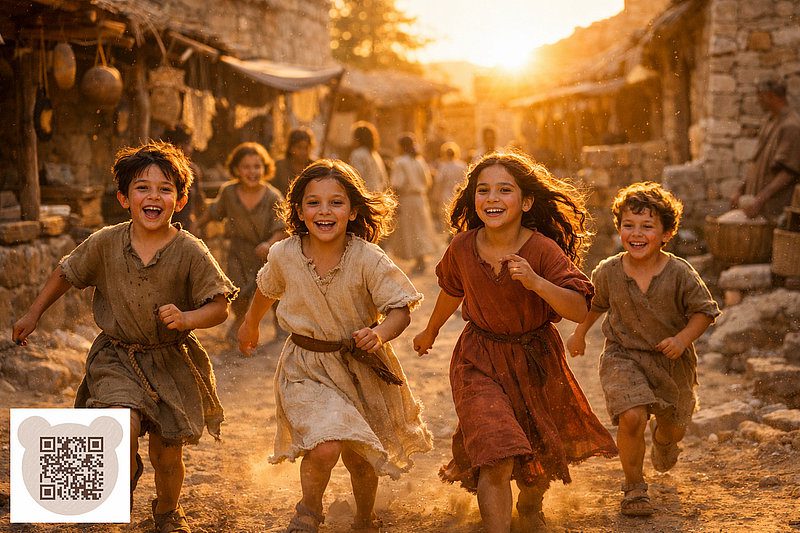
Imagine the world two thousand years ago: the dusty roads of Palestine, bustling Eastern marketplaces, and children whose childhood looked nothing like ours. Life in those days was harsh—there were no tablets or bright toys. Children helped their parents tend sheep, carried heavy jars of water, and learned to grow up far too soon. In that world, only strength and power were valued, and children were often scarcely noticed at all.
And then, upon those very roads, there appeared a Man who changed everything. Jesus Christ came into the world as the Son of God, clothed in heavenly power, yet He became truly Human—just like us. He knew weariness, thirst, and joy. And most astonishing of all: though He was a Great Teacher, the first people He turned to were children.
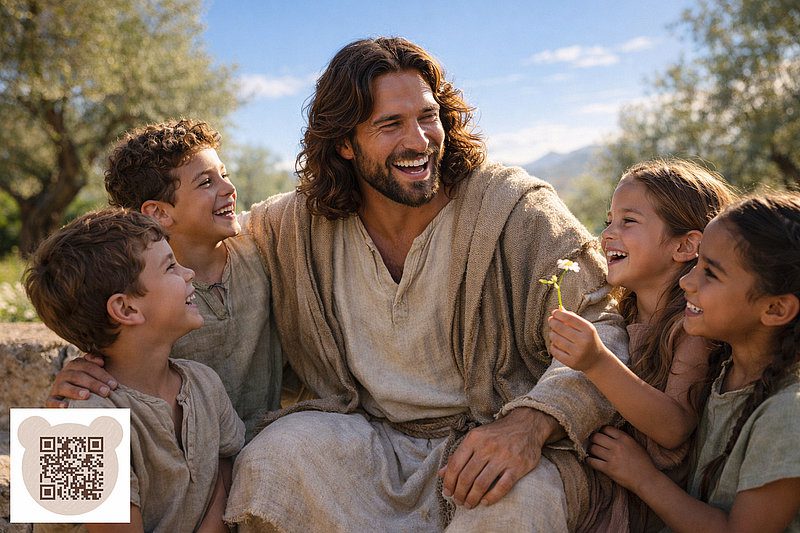
How did Jesus treat children? He loved them with all His heart. When important adults tried to send little ones away so they would not disturb “serious conversations,” Jesus stopped them and said, “Let the children come to Me.” He would sit right down on the dusty ground beside them, laugh with them, and hold them up as an example for grown-ups.
Jesus brought into that stern world a new and gentle truth: every child is a treasure, and kindness and a sincere heart are worth more than any riches.
He carried a light that never fades. To adults He spoke of mercy, and to children Jesus Christ gave the deep assurance that they are protected and loved. Today, the story of Jesus is not merely a legend from long ago, but a living reminder to every modern child: you matter, you are heard, and in your heart, too, lives a spark of that very Light which shone above Bethlehem on the night of Christmas. It is the story of the One who became Human so that He might remain, forever, our truest and kindest Friend.
Support the creation of new fairy tales for children! ❤️
The Mystery of the Christmas Night: a Journey toward the Light
…And once more we are carried back two thousand years, to the hot and dusty land of Palestine.
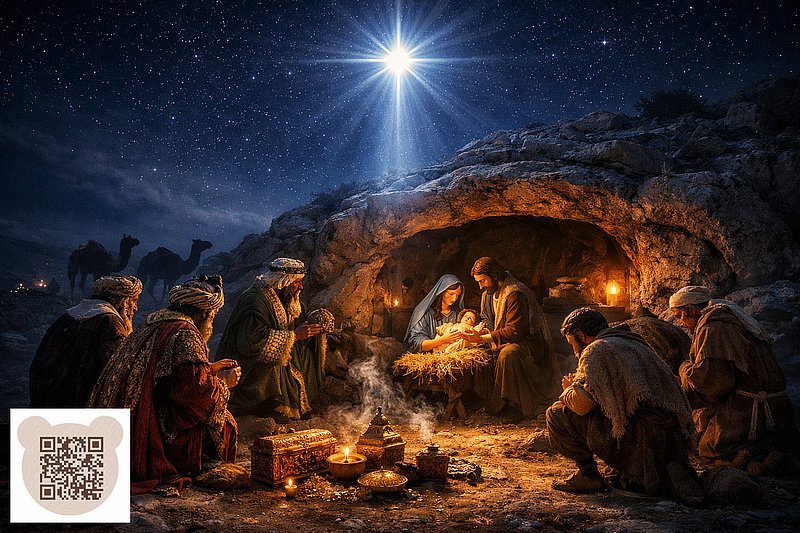
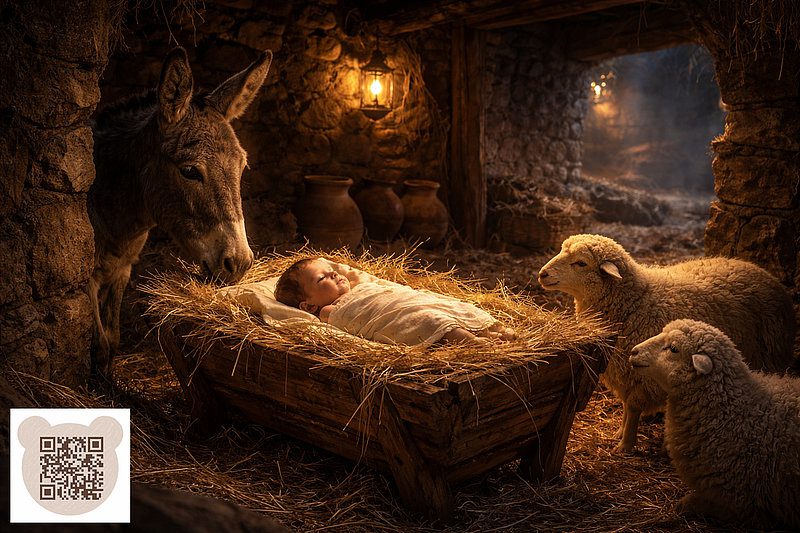
How was Jesus born? The day had been long; the air lay heavy with the scent of sun-warmed grasses and the grit of the road, and the town of Bethlehem rang with many voices. Yet in its quietest corner, within a cool stone cave where sheep and little donkeys often hid from the blazing heat, time itself seemed to stand still. It smelled of fresh, dry hay and warm milk. In that gentle darkness, to the steady snuffling of kind animals, the greatest wonder of all came to pass—the Child Jesus was born into the world.
His first cradle was a manger—no more than a simple wooden trough for hay. The animals drew close and warmed the baby with their breath, as though they understood that within their humble shelter rested the very Son of God, who had chosen to become Man. Jesus entered the world not in a glittering palace, but here among plain and homely things, to show that true love and true light have no need of gold; they are born in stillness and in the purity of the heart.
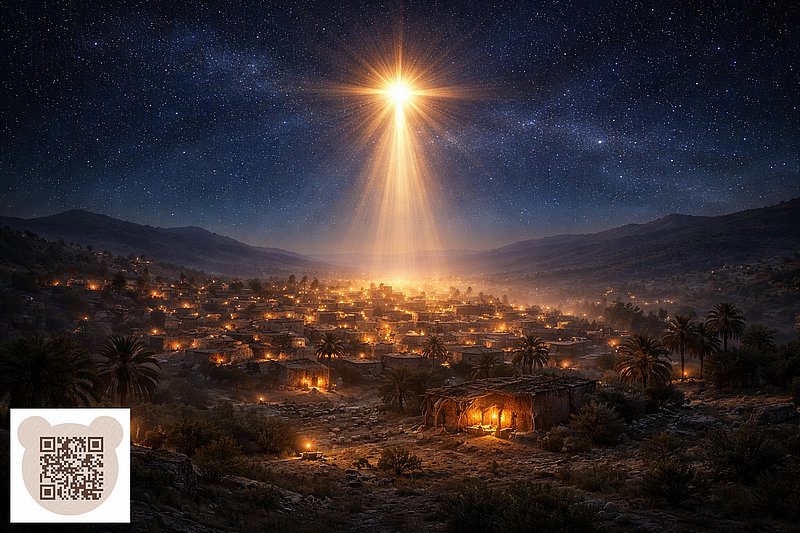
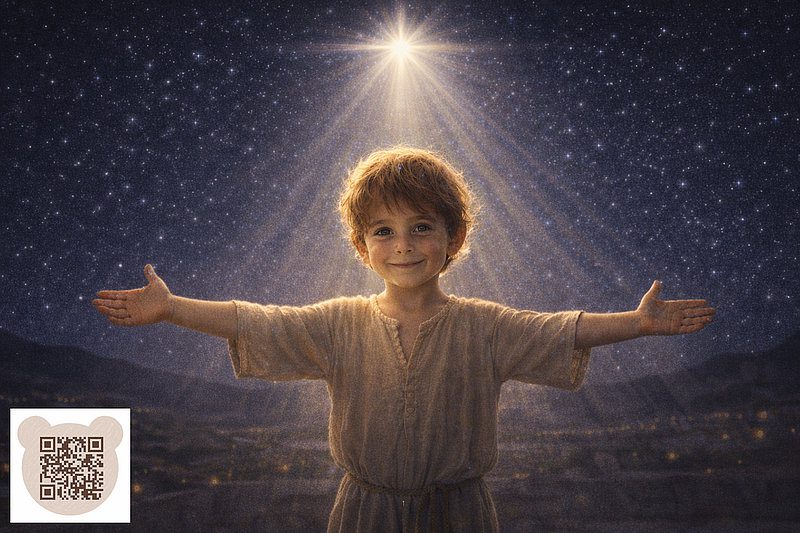
At that very moment, high in the deep, inky-black sky, a mighty Star of Bethlehem flared into being. It shone so brightly that its light could be seen from the far ends of the earth. Drawn by that light came first the simple shepherds, to whom Angels—radiant messengers of heaven—sang a beautiful song of peace and joy. And after them arrived wise men from distant lands. They journeyed long across the sands, guided by the star as by a wondrous compass, to bring their gifts to the Child.
They laid before the manger gold, frankincense, and myrrh. The frankincense filled the cave with a sweet and solemn fragrance, such as one finds in holy temples, while the myrrh—tiny drops of tree resin—carried a sharp and curious scent. With these gifts, the wise men declared that before them lay not merely a child, but the great King of Love, who had come to live a human life, to know both joy and sorrow alongside us.
This story of Christmas still warms our hearts today. It reminds us that when we light candles and give gifts, we are, in a way, returning to that cool cave, where among hay and the gentle warmth of faithful animals began a miracle that changed the world forever. And even now, the light of Christmas lives on in every kind word and in every smile we give to one another.
The Story of How Heaven Was Joined with Earth
Every great story has a beginning, and the beginning of Jesus’ story was truly wondrous. Imagine this: He was the only One in the whole world who had two homes—Heaven and Earth. As the Son of God, He had always lived in a dazzling light of love and joy, where there is no pain and no sorrow. Yet Jesus loved people so deeply that He chose to become one of us, so that He might understand us not from afar, but truly—feeling the cold and the thirst, the delight of play, and the gentle warmth of a mother’s hands.
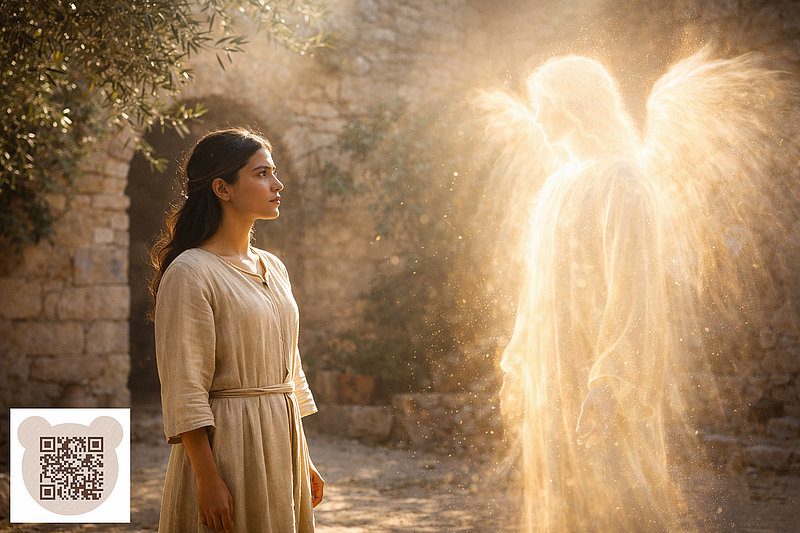
For His earthly birth, God chose two people of the kindest hearts. His mother was the Virgin Mary—a young woman with a heart remarkably pure and brave. One day, a shining Angel appeared to her and brought astonishing news: she would become the mother of the Savior of the world. Mary did not tremble with fear; she trusted God, and from that very moment the great mystery of Christmas began.
To help her and to protect the Child, God entrusted righteous Joseph. He was a wise and diligent man, a humble carpenter who knew how to build sturdy homes and mend what was broken.
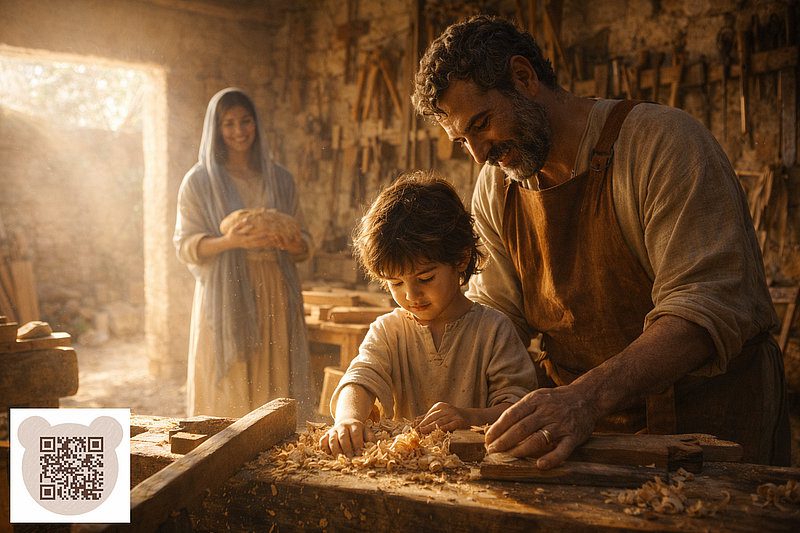
Jesus was born into a family that held no chests of gold, but was rich in love and care. He grew up in the small town of Nazareth, helping Joseph in the workshop, breathing in the scent of fresh wood shavings and touching the timber with His own hands. Thus, within Jesus, the impossible was joined together: He was the Almighty God who created the stars, and at the same time an ordinary little Boy who learned to walk and obeyed His parents.
Why does this matter so much to us today? It means that when you feel sad or afraid, Jesus understands you better than anyone in the world. For He does not merely watch us from Heaven—He Himself was once a child. He knows what it is to grow, to discover the world, and to make friends. Jesus came from God to people to become that very bridge by which each of us can reach toward Heaven through a prayer or a kind deed.
His beginning lies in boundless love—a love that chose to become Human, so as to remain with us forever.
You know, dear one, when Jesus was little, He too gazed at the stars and loved the warm, wholesome bread His mother baked. And when you do something kind today, you become just a little like Him—that very Boy from Nazareth who brought into the world the greatest light of all.
Let Us Speak Heart to Heart: A Conversation After Reading
This story is only the beginning of a much larger conversation between you. For it to truly “take root” in a child’s soul, try talking it over without heavy sermons or stern lessons. Here are a few gentle ideas to help:
Questions That Bring the Story to Life
What do you think we would hear if we stepped into that cave to see Jesus? (The soft snorting of a donkey, the whisper of hay, Mary’s lullaby?) — this awakens imagination.
Jesus was both God and an ordinary boy. What do you think He liked to play, or what might He have enjoyed making in Joseph’s workshop? — this helps a child feel closer to Christ.
Why do you think the shepherds and the wise men rejoiced so greatly at the Child, even though He gave them no toys and no gold? — this helps reveal the value of love and hope.
If you had been there that night, what would you have whispered into little Jesus’ ear? — the most personal and tender question of all.
Guidance for Parents
Listen more than you speak. At the age of six or seven, children often form the most astonishing ideas about God and the world. Do not correct them sharply (“No, that’s wrong”); instead, say, “What an interesting thought—I’ve never considered that before.”
Focus on salvation of the soul. Emphasize that Christmas is a feast reminding us that we are not alone. Jesus came to be a Friend to whom we can tell any secret.
Turn meaning into action. Ask, “How can our family become little ‘rays’ of that same Star for someone today?” Perhaps by baking biscuits for a neighbor or embracing someone who feels sad.
Draw together. Invite your child to draw “the kindest moment of the story.” Let them choose for themselves: the shining Star, the warmth of the cave, or the gentle eyes of the animals.
Your aim is to leave a child with a sense of warmth and light. If, after reading, they simply want to snuggle close to you in silence, then the miracle of Christmas has already taken place in their heart.
How It Truly Was: A Journey into the Past
At times it may seem that Christmas is merely a beautiful fairy tale, yet by 2025 scholars and archaeologists know for certain: this story unfolded in real time and in a real place. Let us peer into that world.
Yeshua
A “home” name. Among family and friends, the Child was called Yeshua. That is how His name sounded in Aramaic, the language spoken in Judea at the time. It means “God saves.” And the word “Christ” is not a surname, but a title of honor. It means “The Chosen One,” or “The One Anointed with special power.”
Cave-Houses
In the town of Bethlehem, many homes were built right at the mouths of caves. This was very practical: the stone kept the dwelling cool in the heat and warm in the cold. In such caves (called a “grotto”), animals were sheltered for the night. It was there, in the natural warmth of stone and hay, that Jesus was born.
Stone or Wooden Mangers
Yeshua’s cradle was a manger—a feeding trough for donkeys and sheep. In those days, such mangers were often carved straight from stone or fashioned from wood. To make it soft for the Infant, it was filled with fresh, sweet-smelling hay. It was the simplest, yet the kindest and safest cradle in all the world.
Scholar-Travelers
The wise men who came bearing gifts were not merely wealthy men. They were sages and astronomers of their age. They studied the heavens as closely as modern scholars study the cosmos today. The Star of Bethlehem became for them a true celestial “beacon,” guiding them toward a great discovery.
Gold, Frankincense, and Myrrh
These gifts were very precious, yet they were not given for the sake of riches. Frankincense and myrrh are fragrant drops of resin from rare trees. When placed upon glowing coals, they fill a room with a wondrous scent. Frankincense was brought to Jesus as God, gold as the King of Love, and myrrh as a Human Being who would live an ordinary life with all its joys and hardships.
A Home in Nazareth
Though Jesus was born in Bethlehem, He spent His childhood in the small town of Nazareth. There He learned the carpenter’s craft from Joseph: sawing wood, driving nails, and making furnishings for neighbors. Modern scholars and archaeologists in 2025 have uncovered remains of ancient workshops in that region, confirming that Jesus knew honest labor and loved His work.
Clothing and Daily Life
People then wore long tunics of linen or wool, with simple leather sandals upon their feet. Journeys from town to town took many days, and travelers went on foot or rode upon donkeys—the most reliable “transport” of that age.
But Why So? Answers to Important Children’s Questions
Children often ask questions that can leave adults searching for words. Here are simple ways to answer them clearly and truthfully:
How can we explain to children who Jesus Christ is?
Jesus is the Son of God and the kindest Teacher in all history, who came into our world to teach people to love and forgive one another. He showed that a good heart can overcome any darkness and give hope to the whole Earth. At Christmas, we celebrate His birthday as the coming of a Light that always stays close to each of us.
Why did God become a small child instead of coming at once as strong and grown?
To show that He understands everyone—both adults and the very youngest. Jesus wished to live the whole of human life from the very beginning, just as you do: learning to walk, to play, and to make friends. In this way, He became truly close to us.
Why is Christmas celebrated at night or early in the morning?
Because that radiant Star was lit in the night sky while all Bethlehem slept. Night is a time of quiet and mystery, and Christmas is the kindest mystery in the world. We light little lamps on our trees to remember how, in that dark night, the first ray of Light appeared in the world.
Why do we celebrate Christmas in winter?
Though in Judea—where Jesus was born—snow rarely falls even in winter, people chose this season because it is the darkest time of year. Christmas reminds us that when nights grow longest and coldest, a Light comes into the world to warm each of us. Thus the ancient story joins hands with our lives today.
And where is Jesus now?
He returned to His heavenly home, yet He is always near. We cannot see Him with our eyes, but we can feel His presence with our hearts—when we do something kind, when we feel peace, and when we love one another. He is like the air: unseen, yet impossible to live without.
Why was He given gold if He was poor?
Gold was a symbol that Jesus is a King—but not a king who sits upon a throne and commands armies. He is the King of Love. The wise men brought this gold to show that what Jesus brought into the world is the greatest treasure on earth, more precious than any wealth.
Why did the Angels sing to the shepherds?
The shepherds were very simple and humble folk. They worked through the night in the fields, guarding their sheep. The Angels wished to show that the joy of Christmas is given to everyone—not only to the rich or famous. Heaven sang for those with kind and hardworking hearts.
What did Jesus ask of people above all else?
He left us one greatest rule: “Love one another as I have loved you.” He asked us to be merciful, to forgive wrongs, and to help those who feel sad. This is the finest gift we can offer on His birthday.
Parental Doubts: Answers to “Those Very Questions”
When we want to speak to children about the Feast of the Nativity, many questions arise within us as well. Here you will find the most common doubts parents have—and simple, reassuring answers to them.
How can I explain the birth of Jesus to children if I am not very religious myself?
Think of it as a story about absolute Goodness and Light. Even if you seldom step inside a church, the values Jesus brings—love, forgiveness, care for the weak—are close to every human heart. Tell your child about Christmas as the birthday of Love that came into the world to make people kinder.
At what age is it best to begin talking about faith and Christmas?
The age of six or seven is ideal. At this stage, children are especially sensitive to images and symbols. What matters is to speak without lecturing and through things they can easily picture: the scent of hay, the glow of a star, and the story of a little Child. The key is not to burden them with difficult terms, but to let them feel the atmosphere of wonder.
What should I do if my child asks “awkward” questions that I don’t know how to answer?
Do not be afraid to say, “That’s a wonderful question! Let’s look for the answer together.” This is far more valuable than an invented reply. Christmas is a mystery, and admitting that we do not know everything about Heaven is both honest and deeply human.
How can we keep Christmas from becoming just another day of exchanging gifts?
Gifts are a beautiful thing—the wise men brought them too. But try adding a tradition of a “gift for the heart.” Ask your child, “What kind deed can we do today in honor of the feast?” This gently shifts the focus from receiving to creating joy through giving.
Should we talk about the hardships that Jesus’ parents endured?
At the age of six or seven, it is better to focus on protection and care. Speak of how Joseph watched over Mary and how God kept them safe. This gives a child a sense of security. You can speak of more complex historical events when they are older.
How can we make the story of Jesus interesting for a modern child?
Draw parallels with their own life. Jesus was little too. He helped His parents. He valued friendship. When a child understands that Yeshua (Jesus) is not merely a figure in a picture, but Someone who understands their feelings, the story comes alive all on its own.