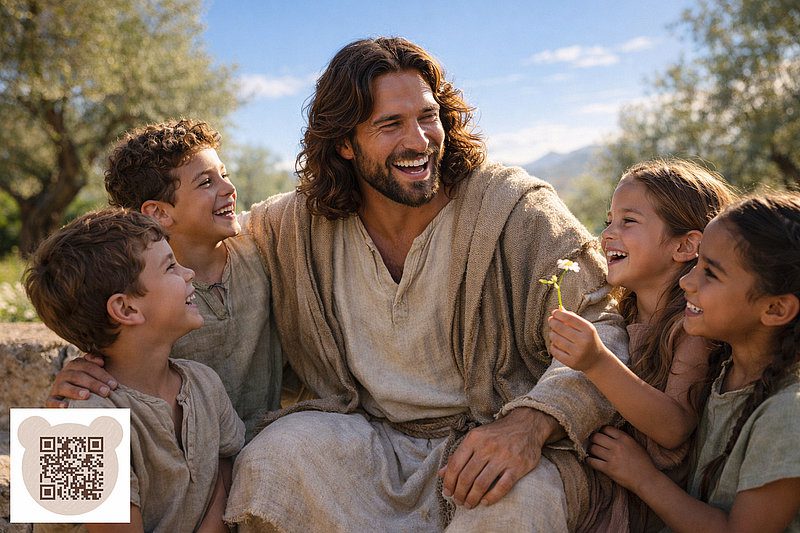
What was Jesus like as a child? A new Christmas tale draws back the veil of mystery. This is a story for children about Jesus and His fifth Christmas in Nazareth. About the day when He received His first tool, and understood that the most precious gift is the power to warm another’s heart. This tale of Jesus’ early years is rooted in real historical events — see the explanations at the end of the page. Readers will also find a plan for nurturing family conversations — you may skip it or use the suggested questions. You may also create your own — the most important thing is for your little one to feel the weight of the moment, just as young Yeshua did.
The Fifth Christmas of Little Jesus

Dear friends! In this story you will encounter the name Yeshua. Do not let it trouble you — this is how the name of Jesus sounded in His native Aramaic in His hometown of Nazareth. I chose it so that you and your child might undertake a true journey through time and behold not merely an icon, but a living, diligent boy who walked the dusty roads of Nazareth two thousand years ago. This “tale-true,” rooted in the customs of that age, seeks to make this meeting with the Savior on His Fifth Christmas especially close and warm for every little heart.
Part 1: Morning of the Fifth Christmas
Morning in Nazareth seeped through the narrow window with gentle gold, brushing the ruddy hills of Galilee. Five-year-old Yeshua opened His eyes and lay still, breathing in the sounds and scents of His home. This was the day of His Growing — the fifth year, when in Judea a boy was no longer counted a babe, but became a small helper.
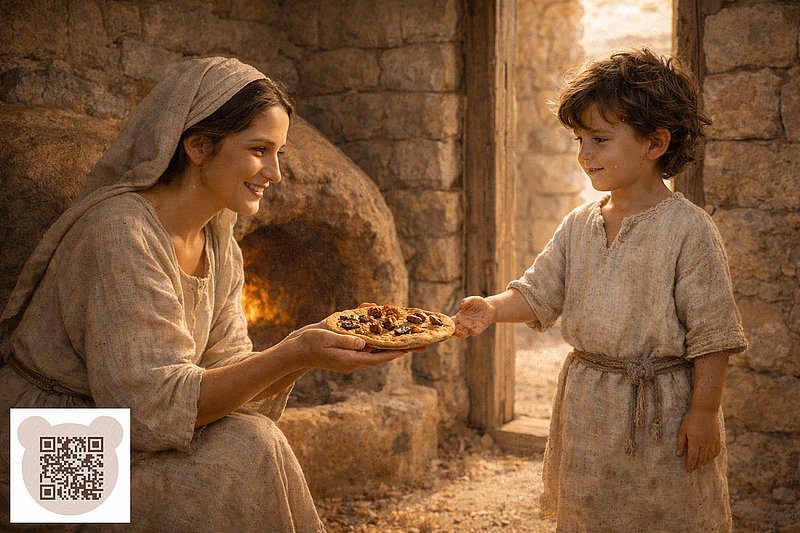
Mother Mary was already bustling by the hearth. Yeshua watched as she carefully laid special flatbreads upon the heated stones. On ordinary days the bread was plain, but today Mary had added precious dates saved since autumn and a little mountain honey to the dough.
“This is for our festive supper, Yeshua,” she said, gently touching His shoulder. “This evening, when the first star appears, we shall break this bread with your father, and invite our lonely neighbor, old Akim. To feed a guest on such a night is a great joy.”
Yeshua nodded, sensing the importance of the moment. The feast had not yet come, but its promise already filled the house with warmth. Then another sound drew His ear. From the workshop drifted the steady rasp of wood. Yeshua stepped to the threshold and saw His father. Joseph bent over the bench, shoulders moving to the rhythm of the plane, while thin curls of fragrant cedar flew from the tempered iron.
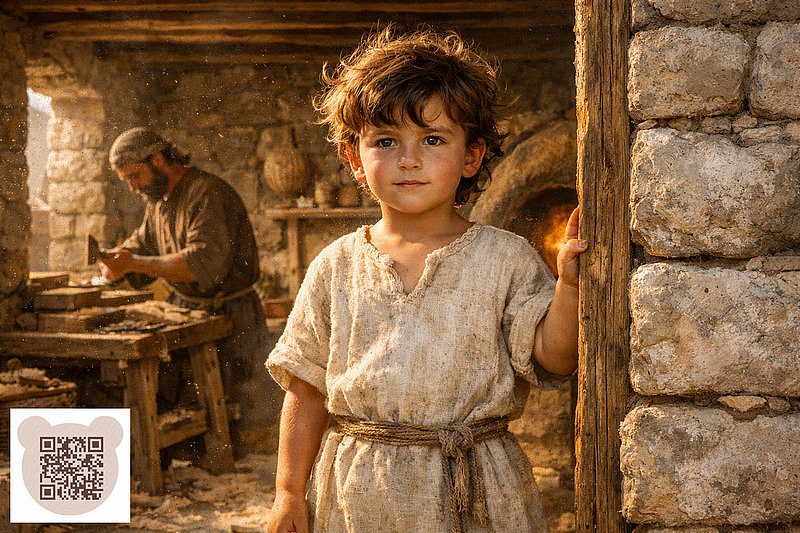
“Come here, son,” Joseph called without turning. “Let the bread rise in the hearth — our task today lies in the workshop. Before a man sits at the festive table, he must bring some good to his household.”
The whole world of that morning suddenly seemed to Yeshua precious as gold: the promise of the sweet supper and the specks of resin on his father’s hands. The road to the feast passed through kindly labor, and Yeshua stood ready to begin.
Conversation with your child about goals and waiting
- What to discuss: Ask your child, “Why didn’t Yeshua eat the flatbread right away? Is it hard to wait for the feast all day? Why did Mother invite the lonely neighbor?”
- Meaning: We teach a child purpose and patience. A feast is not simply food, but the fruit of a day filled with care and good deeds.
- Task: Plan a small good deed to do together “before evening comes.” For example, prepare a simple gift or tidy up a shared space.
Part 2: The Father’s Gift and Care for the Voiceless
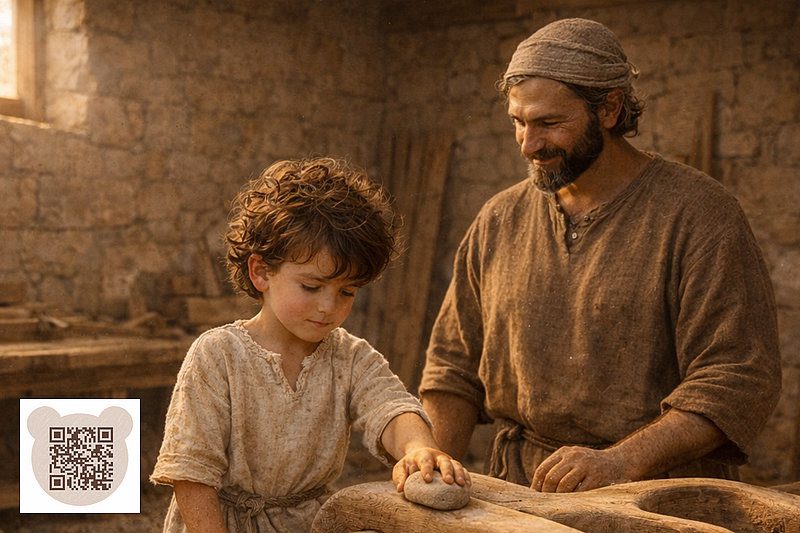
Joseph was working on a yoke for the oxen—a heavy, curved beam of wood meant to rest across the animals’ necks. The task was not simple: the timber was knotty and stubborn. When Yeshua approached the workbench, His father handed Him a small, smooth stone.
“On the day of your fifth year, my son, you receive your first true tool,” Joseph proclaimed solemnly. “This is your whetstone. It will teach you patience, and show you what real craftsmanship means.”
Yeshua took the stone with pride. He slid His palm along the inner side of the yoke and felt a sharp ridge.
“Father, the wood bites here,” He said. “The ox will hurt while it works.”
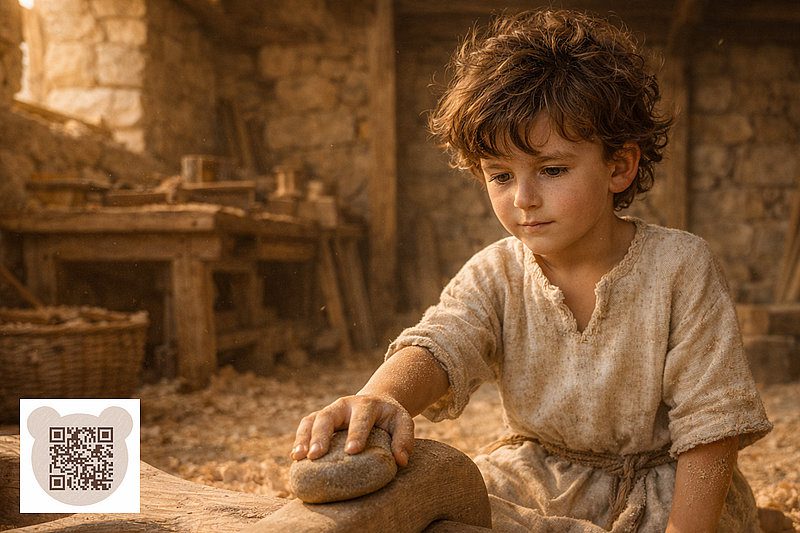
Joseph nodded, approving the boy’s keen eye. Yeshua set to work. For a long while, He steadily smoothed each rough place. He pictured the great strong oxen that would labor all day beneath the burning sun.
Yeshua wanted their burden to be even a little lighter, and polished on until the wood grew as smooth as a river stone.
Conversation with the child about responsibility
- What to discuss: Ask your child, “Why didn’t Joseph give Yeshua a toy, but a stone for smoothing? Why is it important to think of others—even those who cannot say ‘thank you,’ like the ox? What is a true gift?”
- Meaning: We introduce the idea of responsibility. Yeshua receives His first “grown-up” tool, and His first task is caring for a voiceless creature. This teaches that the quality of our work is itself an act of love toward our neighbor.
- Activity: Practice at home. Ask your child to help “make something smooth”—fold laundry neatly or dust a shelf. Point out how their work helps others.
Part 3: Noon in Nazareth
The sun stood at its highest, and the dust along Nazareth’s roads lay hot as a baker’s hearth. Yeshua stepped from the house carrying His favorite clay jug—round-bellied, fitted with a sturdy handle, darkened by water and years. This jug was like an old companion, for many times they had walked together to the spring and back.
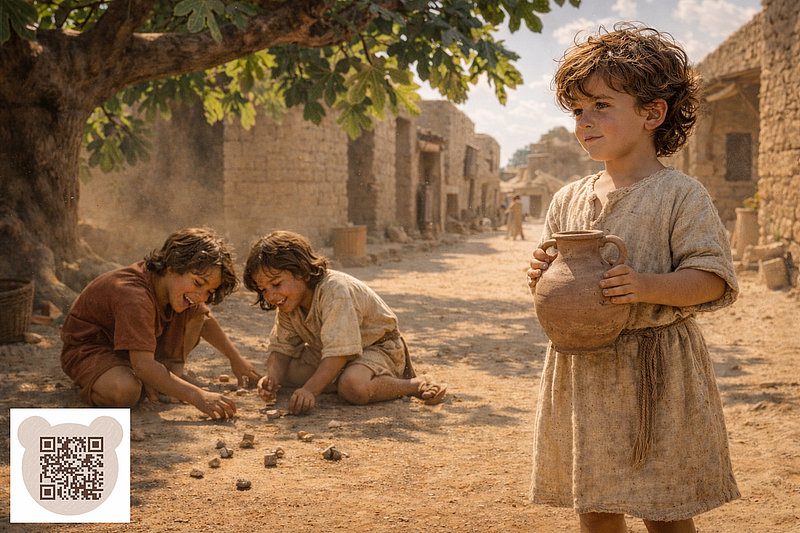
Passing beneath an ancient fig tree, He saw John and several village boys. They were noisily playing knucklebones—tossing smooth sheep bones into the air and catching them on the backs of their hands.
“Yeshua, come!” cried John, deftly catching a bone. “Try your luck while the sun hangs overhead!”
Yeshua could not resist. He set the jug in the shade and came toward the boys.
“Only one throw,” He told His friends. “I must not linger.”
The bone spun upward, turned midair, and landed obediently upon His palm. The boys hummed their approval. For a heartbeat, Yeshua longed to stay—to forget the heat and the weight of the jug. But He remembered the morning scent of cedar and His father’s words. Yeshua lifted the jug, straightened His back, and, striving to walk solemnly as grown men stride to market, said:
“Another time, John. Today I have tasks more urgent than games. I am now my father’s first helper!”
He even raised His chin a little higher, savoring the warm pride swelling within him. Yet the heavy jug tugged at His hand, reminding Him that to be truly grown means finishing what one begins. His father had taught Him that too. So the boy continued on His way.
The well was crowded. Women called to one another over the heavy clay jars bumping at their hips. Leather buckets creaked and splashed as they hauled cold water from the deep. Nearby, Yeshua noticed a traveler. She sat upon a stone, veiled by the edge of her dusty mantle. Her shoulders drooped with weariness, and her lips were parched.
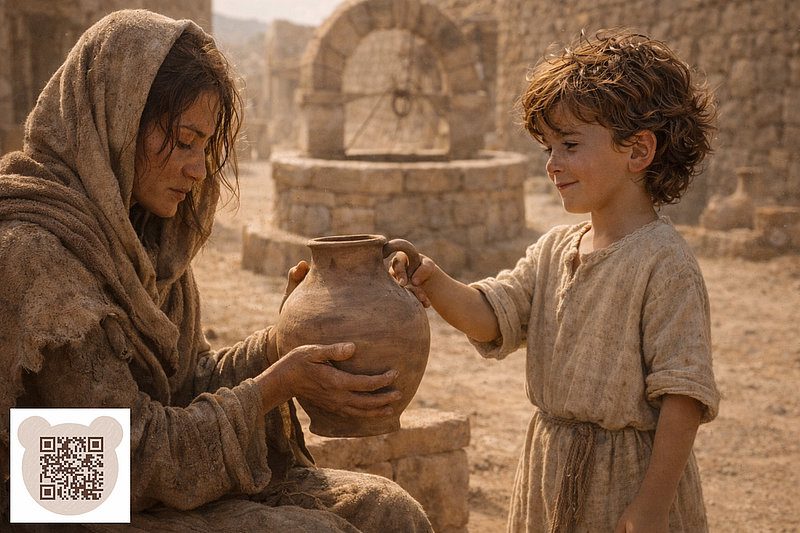
Yeshua filled His jug. The water was icy, beads running down the sides beckoned His thirsty mouth. The game had left His throat painfully dry. He raised the jug toward His lips—and stopped. He remembered Mary’s teaching each morning: “Remember, Yeshua—one sip given to the thirsty is sweeter than a whole well kept for oneself.”
The boy lowered the jug. Drawing a deep breath, He stepped toward the woman and offered the water.
“Drink, lady. You need it.”
The traveler lifted her eyes, full of surprise and gratitude, and took a long drink. Yeshua watched, and felt His own thirst ease in a quiet, wondrous way. When He filled the jug again for Himself, the water tasted alive and sweet as pure honey.
Conversation with your child about temptation
- What to discuss: Ask your child, “Was it hard for Yeshua to leave his friends? Why did He act a little ‘important’? What did He remember at the well?”
- Meaning: We talk about resisting sudden impulses—games versus duty—and choosing purpose over immediate desire.
- Activity: Try “offering first” today. Invite your child to offer a treat or fruit to someone in the family before taking one themselves.
Part 4: Benjamin the Lame
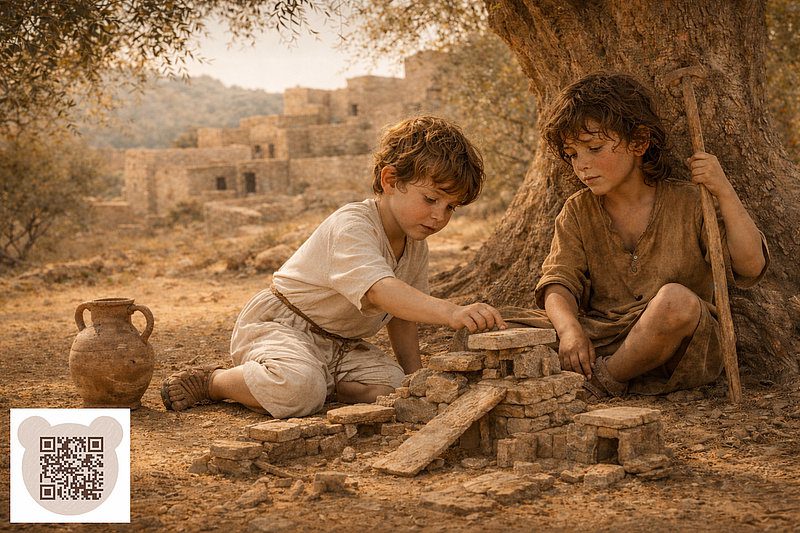
Returning with the full jug, Yeshua noticed Benjamin, whom the village called the Lame One. The boy sat in the shade of an ancient olive, leaning against its rough, knotted trunk. His legs were thin and still—motionless since birth. Not far away other children dashed and shouted, playing tag. Benjamin watched them with a long, wistful gaze.
Yeshua’s heart tightened. He set the jug beneath the shade and knelt in the dust beside his friend.
“Let’s build,” He said simply.
The boys gathered flat stones, pale pebbles, and dry twigs. A strange little city began rising in the road dust beneath their hands. It had no high thresholds or steep stairs such as other children loved to construct—those obstacles would make Benjamin helpless. Instead, Yeshua laid gentle slopes of pebbles and wide level paths.
“In this city,” Yeshua told Benjamin, “anyone may visit a friend. There are no barriers here.”
Benjamin smiled, and his hands—white with dust—worked as swiftly as Yeshua’s.
Conversation with your child about inclusion and empathy
- What to discuss: Ask your child, “Why didn’t Yeshua run to the other children? What did He do to help His friend feel equal? Must one run and play to be included?”
- Meaning: We offer a lesson on inclusion and empathy. A true friend is one who shifts plans or rules so that there is room for everyone.
- Activity: Try a “kind construction” game. Build something together with blocks or bricks, choosing roles and making decisions peacefully—ensuring the activity suits all.
Part 5: The Wooden Donkey
The city of stones and splinters was complete. Yeshua slipped His hand into the fold of His linen tunic and drew out a small wooden donkey He Himself had carved from a scrap of olive wood. The donkey had long ears and a comically short tail. Yeshua was proud of His handiwork and longed to show it to His father that evening as proof of growing skill.
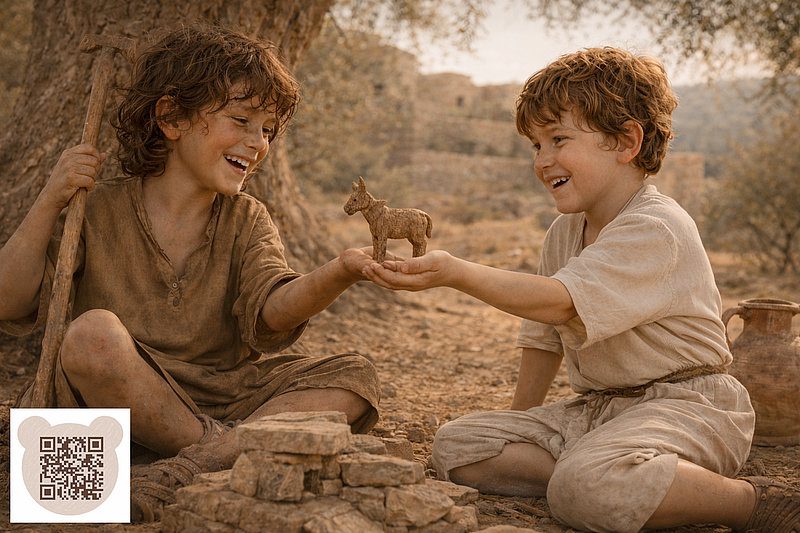
He meant to place the figure by the main gate of their little city. When Benjamin the Lame saw it, he fell silent. Wonder flashed in his eyes, mingled with sorrow: he had no tools to shape wood, and no carpenter-father to teach him such craft.
Yeshua looked upon the donkey, then at his friend’s shining face. For a moment, He felt reluctant to part with His new creation—but the joy in Benjamin’s eyes shone brighter than the polished grain of the wood.
“Take him, Benjamin,” Yeshua placed the figure in his friend’s hand. “Let this donkey guard your city. And tomorrow, I shall teach you how to choose the smoothest stones for building, and how to stack them so your city will withstand any storm, and no wind shall shake it.”
Benjamin pressed the wooden donkey to his chest and smiled wide. Yeshua felt warmth spread through His own heart, sweeter than pride in a well-made thing. To give away what one loves—that was the greatest gift of His Day of Growing.
Conversation with your child about generosity and the joy of giving
- What to discuss: Ask your child, “Was it easy for Yeshua to give away His beloved toy? Why did He choose to do it? How did He feel seeing Benjamin’s joy?”
- Meaning: We explore generosity and the willingness to part with possessions. A child learns that another’s happiness is of greater worth than any object. This is an important step in developing empathy and understanding that joy multiplies when shared.
- Activity: Invite your child to choose one of their toys (not necessarily the favorite, but one they value) and decide together whom they might gift it to or share it with, to bring someone else delight.
Part 6: The Broken Jar
On His way home, Yeshua had to cross the market square. At midday it was clamorous: donkey drivers bellowed at spice merchants. The air hung thick with the scent of dried fish and cloves.
Suddenly, a quarrel flared directly before Him.
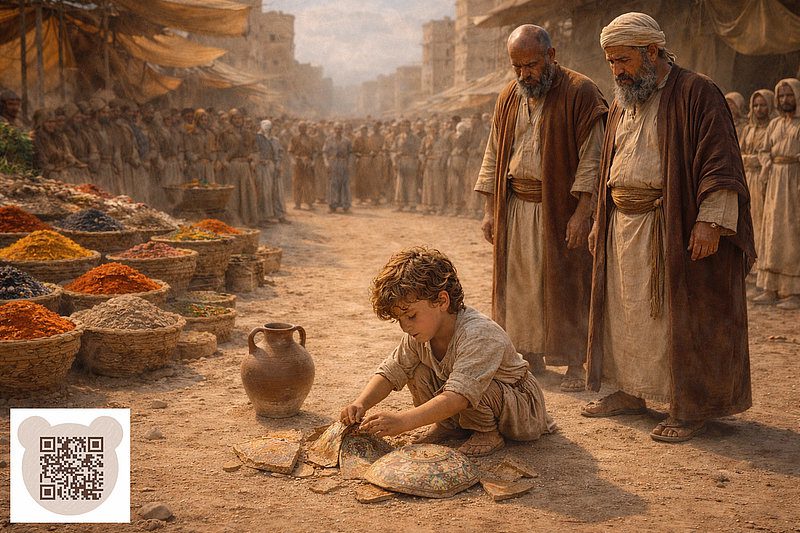
Two merchants were shouting so loudly that Yeshua’s ears rang. At their feet lay the shattered remains of a great clay jar—a heap of sharp, dangerous shards. One merchant blamed the other; the second waved his arms in return. The crowd began to scowl and join the argument. Anger spread from one to another like a forest fire.
Yeshua stopped. His jug of water was heavy, and His legs were weary—but He sensed He must not pass by. He recalled Joseph’s words: “A man bears peace into his home and into his town.”
Yeshua set down His jug, crouched, and began gathering the broken pieces. Slowly and carefully He worked. One by one He placed the clay fragments into a neat pile away from the road where no one would be hurt.
The merchants, ablaze with fury, did not notice at first. But when their eyes fell upon the small boy quietly tending the aftermath of their rage, the shouting ceased. A hush spread so deep that one could hear cicadas clicking in the shrubs.
The grown men felt a sudden sting of shame at their noise and anger before this unusual child. One merchant sighed, the other lowered his head, and wordlessly they bent to help Yeshua. Their anger seemed to fade under the blazing sun, and soon the market hummed peacefully once more.
Conversation with your child about leading by example
- What to discuss: Ask your child, “Why didn’t Yeshua shout with the adults, as others did? Would that have helped? How did His quiet action change the merchants? What does it mean to be a peacemaker?”
- Meaning: We discuss the power of personal example. One need not argue or prove oneself loudly. A simple act of kindness can speak louder than any words. This is a lesson in shaping the world around us while keeping inner calm.
- Activity: Try the “Quiet Peace” game. If home or playground becomes too loud, invite your child not to shout over others, but to begin a helpful task instead (like gathering toys). Notice how the atmosphere changes.
Part 7: The Price of a Crumb of Bread
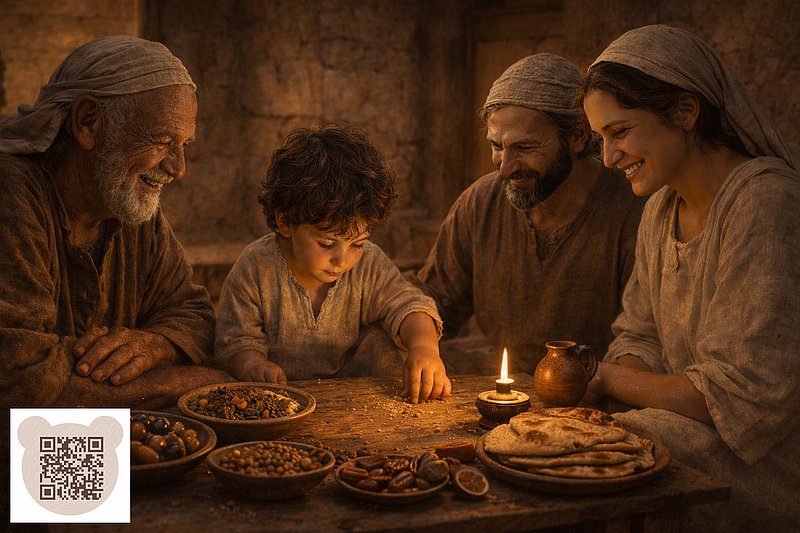
The sun slowly slipped behind the gentle hills of Galilee, and in a small stone dwelling a clay oil lamp was lit. Evening had come—the long-awaited hour of the festive meal. At the low wooden table sat not only Mary, Joseph, and little Yeshua. In the place of honor, just as his mother had promised, sat their elderly neighbor Akim. The lonely man smiled at the flickering flame, and in his eyes shone the quiet warmth of this household.
Before them lay barley loaves, dark olives, dried figs, and those very special honeyed cakes whose sweet scent had teased Yeshua since dawn. There was not a great abundance of food, yet when it is shared with a guest, it feels like a feast.
Before breaking the bread, Joseph gave thanks to Heaven for this provision and for the friends who shared their table. Yeshua ate slowly. Tearing off a small piece of flatbread, He noticed several golden crumbs fall upon the table’s edge. The boy gently gathered them with his fingertips and ate every one.
He looked thoughtfully at His palms, then at the calloused hands of old Akim beside Him. Yeshua remembered one of Mary’s pious teachings: for this grain to grow, someone had plowed the thirsty earth for long hours; had guided the very yoke His father had fashioned; had waited for rain and harvested the stalks beneath the blazing sun. To Yeshua, bread was a treasure not to be cast into the dust—especially when shared with those you hold dear.
Discussion with your child about hospitality and carefulness
- What to talk about: Ask your child: “Why did the honeyed bread taste even sweeter when it was shared with neighbor Akim? Why did Yeshua gather the crumbs so carefully? Whose labor was He honoring in that moment?”
- Meaning: Here we unite the themes of welcoming others and treasuring what we have. A child learns that sharing brings joy, and caring for what we possess shows respect for the work of many hands.
- Activity: Next time you set the table, invite your child to choose “the finest piece” for a guest or family member.
Part 8: The Star of Hope
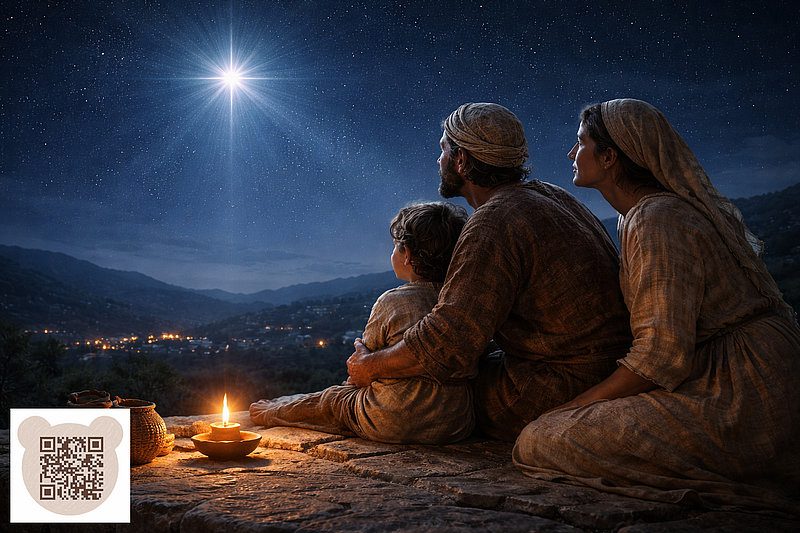
After supper, when neighbor Akim—warmed by kindness and company—returned to his home, the family climbed to the flat roof. In Nazareth this was the most blessed hour—the time to breathe the cool breeze and gaze across the quieting valley. Night spread a deep blue cloak over the Galilean hills.
Joseph wrapped an arm around his son’s shoulders and pointed upward. Among the thousand shimmering lights, one star gleamed clearer and brighter than the rest.
“Look, Yeshua,” whispered the father. “It shines just as it did on the night of Your birth. It is the Star of our hope.”
The boy gazed upward for a long while—the heavens seemed to beckon Him. Then He lowered His eyes to His hands. Through this long day of growing up, they had accomplished much: the scent of cedar resin clung to His skin; road dust settled into His lines; a tiny scratch remained from the carving tool.
These were the hands of a young carpenter—hands of the Helper and Friend He would become for all who would one day seek His warmth.
He closed His eyes, feeling His father’s steady hand on His shoulder and His mother’s gentle gaze. In the hush of night, that small yet already wise child sensed with all His heart: the light of Heaven belongs to every soul.
The Star of Hope shines equally—
…upon His wise father;
…upon lame Benjamin, who now sleeps with the wooden donkey clasped to his chest;
…upon the voiceless ox whose yoke He had smoothed so patiently.
For love and light recognize neither great nor small—they simply warm each heart willing to receive them.
The Fifth Christmas beneath the hot Nazareth sky drew to its end. As sleep overtook Him, Yeshua pondered that true light is born in one’s heart at the very moment one eases another’s burden and makes another’s world kinder.
Little Yeshua had taken His first step along a great path…

Discussion with your child about inner light and true growing-up
- What to talk about: “What do you think Yeshua pondered as He fell asleep? What great truth did He learn by day’s end? Why did He believe that the Star of Hope shines equally for His father, for Benjamin, and even for the ox? Which of Yeshua’s deeds today do you remember most? How did He make someone’s world a little kinder?”
- Meaning: This is the story’s culmination—the insight that links personal labor, kind deeds, and the common good. A child learns to reflect on the day, finding joy not in gifts received, but in the warmth they have given.
- Activity: Before bedtime, recall with your child every good deed they did today. Let their own “star” be the warmest memory of how they helped someone, lightened a burden, or showed friendship.
Support the creation of new fairy tales for children! ❤️


Games to prolong the experience of the Christmas story about the childhood of Christ
- “Sensory Box” for the story
After reading the story about young Yeshua, invite the children to create a “Nazareth Box.”
Contents:
• pieces of bark or wood (texture and scent)
• a small handful of dried lentils or barley (as in the scene with the crumbs)
• pebbles and smooth stones (as in the scene with Benjamin)
• a scrap of leather or suede (for “sanding” like a carpenter)
Purpose:
While you read aloud, the child may handle the objects. Sensory impressions build deeper neural connections between story and reality.
- Advent Calendar of “8 Kind Deeds”
Since the story has eight scenes, it becomes a perfect mini-Advent before Christmas: one day — one scene — one real-life task.
Examples:
After Scene 2 (sanding) — task: “Find something at home that ‘needs smoothing’ — something squeaky or out of place — and fix it.”
After Scene 6 (peacemaking) — task: “Be a peacemaker today: help someone reconcile, or simply smile at someone who looks sad.”
Final conversation: “The Light in Your Heart”
This plan helps you guide reflection after the story, nurturing empathy and emotional awareness. Recommended for children ages 4–7.
Why this approach works:
- Focus on psychology, not dogma. The questions guide emotional intelligence (EQ), empathy, and sensory awareness — skills valuable for every child.
- Cultural literacy. The figures of Yeshua (Jesus), Joseph, and Mary belong to world cultural heritage, much like Greek myths or folk tales. Knowing these stories enriches children of all backgrounds.
- Universal values. Kindness, helping one’s parents, thrift, and willingness to share belong to all humanity, not to one faith alone.
Step 1: sensations and smells
Question: “If you closed your eyes and found yourself in Joseph’s workshop, what would you feel? (The scent of wood, the warmth of sunlight, the taste of honeyed bread.)”
Goal: To develop imagination and sensory memory.
Step 2: choice and responsibility
Question: “Yeshua longed to play knucklebones with the boys — why did He go for water instead? Was it hard to share a sip with the traveler when He Himself was thirsty?”
Goal: Understanding that growing up means choosing what benefits others, not just what we want for ourselves.
Step 3: peacemaking
Question: “Do you remember how Yeshua gathered the broken shards in the marketplace? Why did the grown-ups stop shouting when they saw Him?”
Meaning: The lesson of “creative action.” Sometimes words are not needed. A quiet good deed can change the world around us.
Step 4: the value of small things
Question: “Why did Yeshua gather even the crumbs from the table? Whose labor was He honoring?”
Goal: To cultivate carefulness and respect for the work of others — parents, farmers, bakers.
Step 5: your Fifth Christmas
Question: “At day’s end, Yeshua understood that the Star shines equally for everyone. What kind deeds did you do today that made your inner star shine brighter?”
Assignment for adults: Praise the child for any good deed — even the smallest — done during the day.
A Creative Idea for Reinforcing Meaning
Invite the child to make a “Bag of Good Deeds.” For every kind action (helping Mother, sharing a toy, tidying up after oneself), place one “golden” pebble or a bean into the bag.
By Christmas the bag will have grown heavy—this will be the greatest gift, one the child has “crafted” with their own hands, like a little carpenter from Nazareth.
Why does Jesus behave like an ordinary child in the tale?
In creating this story, I was guided not only by pedagogy, but also by the Church’s teaching on the God-Man. According to doctrine, the Savior was True God and True Man. This means that His earthly childhood was not a mere “pretence” of being a child—He truly grew, learned, and lived through every stage of human life (as the Gospel of Luke 2:52 says: “And Jesus increased in wisdom and stature, and in favor with God and man”).
This is why certain “childlike” traits in the story are essential for spiritual formation:
- The Joy of Responsibility Instead of Pride
When the little Jesus tries to walk with solemn importance, aware of himself as his father’s helper, this is not the sin of pride. In the psychology of a five-year-old, it is the glad experience of belonging to a good and meaningful task. It is the pure joy of a child who has been trusted with a service. For a devout parent, this is an example of how a child can—and should—honor parents by rejoicing in the chance to be useful to them.
- A Conscious Choice of Virtue (Victory over Temptation)
If the little Jesus had not felt the natural childish desire to play with His friends, His walk to the well would not have been an act of will. By showing Him pause for a moment, watching the game, and then choosing obedience to His parents, we offer children an image of a deliberate moral effort. Holiness is not the absence of desires; it is the ability to subject them to love for God and for one’s neighbor. For a child, this is the strongest encouragement of all: “He was like me, and He managed it.”
- The Fullness of the Savior’s Human Nature
The Holy Fathers (such as Saint Gregory the Theologian) emphasized that “what is not assumed is not healed.” Christ assumed the whole of human nature, including childhood with its simplicity, play, and growth. The games of that era (such as playing knucklebones) were part of everyday life. By showing Jesus within the fabric of His own time, we do not “diminish His dignity”; on the contrary, we reveal the greatness of His humility: He Who fashioned the stars humbly plays in the dust of Nazareth and learns the carpenter’s trade.
- A Pedagogical Bridge to Imitation
A “sterilely perfect” image often feels unreachable to children. But when a child sees Jesus as a peer—one who, like him, loves sweet flatbreads, delights in a gift from his father, and wrestles with the wish to play just a little longer—a deep bond of the heart is formed. The child begins to perceive the Savior as a Friend and Teacher, One he longs to imitate in every step.
The Author’s Closing Word
These details were added to the tale with great reverence. They are meant to show that holiness is not a flight from the world, but the sanctification of every moment of life, even the simplest ones. I hope that this living image will help your child love Christ with their whole soul and recognize His presence within their own childhood.
Historical Background: Life in Nazareth 2,000 Years Ago
This Christmas story is a “true tale,” because every image within it rests on the real traditions and daily life of first-century Judea. For the little Yeshua (Jesus), the world was made up of simple yet deeply meaningful things.
- Five years old — an age of transition. In those times, children began helping their parents very early. The age of five was an important threshold: a boy would start learning his father’s craft and the first letters. At this age, a child began to understand himself as part of the community.
- The profession of “tekton.” In the Gospels, Joseph and Jesus are called by the word tekton. We are accustomed to translating it as “carpenter,” but in truth it means a master builder. He worked with both wood and stone. That is why, in this Christmas tale, Yeshua knows the worth of cedar shavings as well as of smooth, well-set stone.
- The yoke for oxen. This is no accidental detail. In antiquity, it was said that the goods made in the workshops of Nazareth were the finest, because they never chafed the animals’ skin. The quality of one’s work was regarded as a form of mercy.
- The structure of the home. Houses in Nazareth were built of stone with flat roofs. In summer, when the rooms below were stifling with heat, families spent their evenings on the roof. It was a place for prayer, for storytelling, and for gazing at the stars.
- The festive table. Flatbreads with honey and dates were a rare treat. Inviting a lonely neighbor to share a meal (hospitality) was considered a sacred duty in Judea, especially on feast days.